Friday, July 28, 2023

What will Spotify’s price rise mean for its recording artists and songwriters? - The Guardian

It had started to feel as though it would cost £9.99 for ever, but Spotify has, after 14 years, finally increased its prices.

Its standard monthly subscription price rose by 10% in more than 50 markets this week, including the US and the UK, and was tentatively welcomed by many in the music industry – but others point out that a £1 rise, to £10.99, will not solve wider quandaries around streaming economics.

The company told subscribers the rise was to “invest in and innovate our product offerings and features, and bring you the best experience”, but tactically avoided mentioning any positive effects for recording artists and songwriters. Their share of streaming income is not determined by Spotify itself – it is also affected by the terms of their record deal, should they have one. Spotify was, however, among services opposing an increase in the royalty rate for songwriters in the US (that opposition failed in July 2022 and the new rate was set at 15.1%).

The price increase comes in the wake of Spotify significantly scaling back its gaping money pit of a podcasting division in June 2023. The company has lost money since its launch, reporting an operating loss of €156m (£133m) for the first quarter of this year and an adjusted operating loss of €112m (£96m) for the second quarter.

Spotify’s stock slumped by 14% on 25 July, the day it published its latest financial results, which fell short of what Wall Street analysts were expecting. In an earnings report just after announcing the price rise, Spotify co-founder and CEO Daniel Ek described the price rises as a “tool in our toolbox”.

A senior record company executive, speaking anonymously, is deeply cynical about the timing of this move given labels have been calling for this for years. “Spotify wanted to make a big move ahead of their stock price tanking – and they thought it would be good press,” they say. “They poorly timed it for their own stock price.”

But Paul Clements, chief executive of the Music Publishers’ Association, views the price rise as generally positive for songwriters. “An increase in subscription fees will help to increase the amount of royalties that flow through to the composers and songwriters we represent,” he says, although “failure to increase subscription pricing for some 15 years has arguably depreciated the value of music per paid user”. For reference, something costing £9.99 in 2001 would cost £17.87 today.

Annabella Coldrick, chief executive of the Music Managers Forum, says artist managers “for a long time have been calling for a price rise” that was in keeping with inflation. “We got the idea that [streaming services] were driving to grow the market, but there comes a point where it’s falling so far behind that it needs to be revisited.” Apple Music has duly increased its prices last year in the US to $10.99 and YouTube Music made a similar move earlier this month.

The streaming services face a delicate balancing act: keen to not price out consumers and derail a growing streaming market, they also face pressure to make streaming pay more to music creators.

David Martin, chief executive of the Featured Artists Coalition, says: “We put our faith in the platforms to be the ones that are able to set price points and move them at the right time. The £9.99 price point was tricky in terms of how it was perceived psychologically, as £9.99 sounds a lot different to £10.99. Now we’re past that, maybe it removes some of the psychological barriers to allow price rises more frequently and more in line with inflation.”

Against the backdrop of a cost of living crisis, increases will have been carefully modelled around price sensitivity. “If it doesn’t lead to a drop off [in subscribers], it will probably lead to another 5% increase next year,” predicts Coldrick.

Netflix, Disney+ and others have managed to regularly increase prices, but can afford to be more bullish because they offer exclusive shows and films. For the music streaming services, who all effectively have identical catalogues, this has been a harder sell. There was widespread paranoia about rivals poaching subscribers by instigating a race-to-the-bottom pricing war such as the one that gripped British tabloid newspapers in the 1990s.

The anonymous senior label executive says a 10% increase is “necessary” but it does not help the industry create new revenue beyond subscription streaming. “Ultimately, we’re still all dividing $11 into pieces,” they say.

The wider concern is that any price rise will benefit record labels and services, with platforms such as Spotify and Apple Music typically taking 30% of all subscription income, much more than the artists, especially those stuck on low streaming royalty deals.

Martin explains that the 10% increase will mean nothing to an artist on a terrible record deal, who still owes money back from their advance and isn’t even getting significant royalty revenue. “It’s not unusual for us to see artists tied into single-digit royalty deals despite their catalogues being on DSPs [digital service providers]. Those terms are so poor in some cases that that might be 10% of nothing being paid through.”

Where and how the extra money is split remains the major bone of contention here. Since 2016, the independent company Beggars Group has paid digital royalty rates of 25%, up from the 18% it was paying since 2009, but this is far from a unilateral policy across labels, especially the majors.

“[The subscription price rise] definitely doesn’t solve all the questions around streaming and fair remuneration for artists,” argues Coldrick, who calls for greater transparency about how streaming income is shared out. “It’s not that artists think this is bad, but there are a whole host of other issues that have to be addressed alongside it, so it’s not just another bumper pay rise for the music business.”

Adblock test (Why?)


from "price" - Google News https://ift.tt/j2qilU8
via IFTTT

Gas prices are going up again. Here's why. - Yahoo Finance

Gasoline prices are on the rise again, just when drivers were getting used to relatively steady prices at the pump.

The national average for gasoline is at $3.71 per gallon, up $0.13 from a week ago, according to AAA. California’s average sits even higher, at $4.93 per gallon, up $0.04 from a week ago.

"It's been notable," Andrew Gross, spokesperson for AAA, told Yahoo Finance. "The driving factor has been the cost of oil."

On Thursday, West Texas Intermediate (CL=F) crude futures hit $80 per barrel for the first time since April.

“Crude oil prices are up $10 per barrel over the last month,” Andy Lipow of Lipow Oil Associates told Yahoo Finance in an email on Thursday. “That is equivalent to a 25 cent per gallon rise in gasoline raw material costs.”

The world's largest oil producers have been implementing output reductions announced over the past year. OPEC hasn't followed through with all of the production cuts, but “the amount that they are cutting in August is substantial—probably closer to 3.3 million barrels per day. It’s a lot,” said Lipow.

The extreme heat in some areas of the US has also impacted refineries, forcing them to cut their production rates of gasoline and diesel supply. Those interruptions could get worse if the US experiences a major hurricane this season.

Gasoline inventories in the US are already 4% lower than this time last year, risking further upward pressure on prices.

“What does this mean for the consumer: I expect the national average to rise another 5 to 10 cents per gallon” in the near term, he added.

Gasoline pumps with Shell's logo are seen at a petrol station in South East London, Britain, February 2, 2023, REUTERS/May James

While gas prices have risen in recent weeks, they remain lower than they were last summer.

The national average of gasoline exactly one year ago was at $4.30 per gallon, or $0.59 higher than it is today.

West Texas Intermediate futures surpassed $120 per barrel in June of 2022, at the same time that inflation in the US peaked.

An overall decline in energy prices since last year has helped bring down the Consumer Price Index this year. Lower prices for fuel oil and gasoline earlier this summer were a factor in helping slow down inflation in June to 3%.

Ines Ferre is a senior business reporter for Yahoo Finance. Follow her on Twitter at @ines_ferre.

Click here for the latest economic news and economic indicators to help you in your investing decisions

Read the latest financial and business news from Yahoo Finance

Adblock test (Why?)


from "price" - Google News https://ift.tt/aRzoGBh
via IFTTT

Do corporations take advantage of inflation with a “profit-price spiral”? - Marketplace

This is just one of the stories from our “I’ve Always Wondered” series, where we tackle all of your questions about the world of business, no matter how big or small. Ever wondered if recycling is worth it? Or how store brands stack up against name brands? Check out more from the series here.


Listener and reader Alice Carli from Rochester, New York, asked this question earlier in the year:

We’ve been hearing lately about the wage-price spiral. Has anyone ever looked into the potential for a profit-price spiral? Where prices go up due to costs, supply, whatever reason, and manufacturers, distributors or platforms not only cover their costs, but make some amount of increased profit that then becomes a new profit “floor”? Do expectations of profit go up and down in a given sector — or just up?

Consumer prices started rising sharply in 2021, peaking at a 40-year high of 9.1% inflation in June 2022. This was caused by a slew of factors including pent-up demand due to the pandemic, supply chain constraints, and higher energy costs spurred by the Russia-Ukraine War. 

Inflation has started to cool down in recent months and is now at 3%, but amid the thick of the battle to tame rising prices, the Federal Reserve had been concerned about rising wages. 

The Fed wanted to prevent the economy from falling into a wage-price spiral, in which rising wages cause companies to hike prices, which then leads workers to ask for higher wages, creating an ongoing cycle. Now, thanks to a new paper from a regional Federal Reserve Bank, we’ve found that rising wages contributed little to inflation. 

But what role do corporations play in all this? As Alice asked, are they taking advantage of inflation to pad their profit margins, thus setting a new standard for profits that will become ever higher and higher? 

Alice’s question intersects with a heated debate happening in economics about a phenomenon that has been coined “greedflation,” in which corporations’ greed for higher profits is driving inflation. 

Former U.S. Labor Secretary Robert Reich has blamed greedflation as the real culprit behind high prices.   

“Corporations are using those increasing costs – of materials, components and labor – as excuses to increase their prices even higher, resulting in bigger profits,” he wrote in an op-ed for The Guardian. 

Former Fed Vice Chair Lael Brainard, in a January speech, spoke of how increasing retail markups in different sectors are a sign of a “price-price spiral,” in which the final price tag has increased more than the costs to make it. 

“Marketplace” spoke to some economists who say that corporations have been able to strengthen their profits, but only temporarily.

“Following the pandemic recession, profit rates did go up. It’s most likely because there was strong demand in the economy — an economy that was supply constrained,” explained Robert Triest, an economics professor at Northeastern University. “Firms were able to take advantage of that situation by raising their prices.”

Sometimes companies that are expecting future inflation will raise prices in anticipation of inflation so they can be ahead of the curve, Triest added. 

But Triest said situations like these are not likely to develop into a price-profit spiral. 

“In the longer run, firms are able to expand capacity and are able to raise their production and compete with each other,” Triest said. As a result, he added, that will help keep their profit margins in check. 

New York University professor Chris Conlon and some colleagues actually set out to discover whether rising corporate profit margins are tied to rising prices. Their research found that between 2018 and 2022, there was zero correlation between companies with the highest markup growth and industries with the fastest price increases. 

Conlon said that inflation is still higher than we’d like, yet corporate profits, in aggregate, have actually been on the decline for the past nine months or so.

“[Economists] typically think of profits not as a cause, but as an effect,” Conlon said. “It’s an output from demand and costs and things like that.”

Conlon noted that profits were indeed high in 2021. But between 2022 and 2023, while prices continued to grow, input costs rose more quickly, which is why profits are going down.

“It would be hard to increase profit margins indefinitely,” he explained. 

While profits are going down, corporations still aim to make sure their profit margins are as high they can get away with, though.

“Companies would love to increase profit margins. They are always greedy in the sense they want to maximize profits,” explained Nick Bloom, an economics professor at Stanford University.

But Bloom noted that that doesn’t mean those profits will constantly rise. 

“It is like an athlete who always tries to be fit — they are not getting continuously fitter, they just want to be as fit as possible at all times,” he said. 

There’s a lot happening in the world.  Through it all, Marketplace is here for you. 

You rely on Marketplace to break down the world’s events and tell you how it affects you in a fact-based, approachable way. We rely on your financial support to keep making that possible. 

Your donation today powers the independent journalism that you rely on. For just $5/month, you can help sustain Marketplace so we can keep reporting on the things that matter to you.  

Adblock test (Why?)


from "price" - Google News https://ift.tt/zRc6UFK
via IFTTT

USD/JPY Price Analysis: Reverses south swiftly as investors assess BoJ policy - FXStreet

Share:

  • USD/JPY shed gains and reverses quickly after the BoJ policy announcement.
  • The US Dollar Index is juggling in a narrow range around 101.80 after a rally as the US economy turned surprisingly resilient than expected.
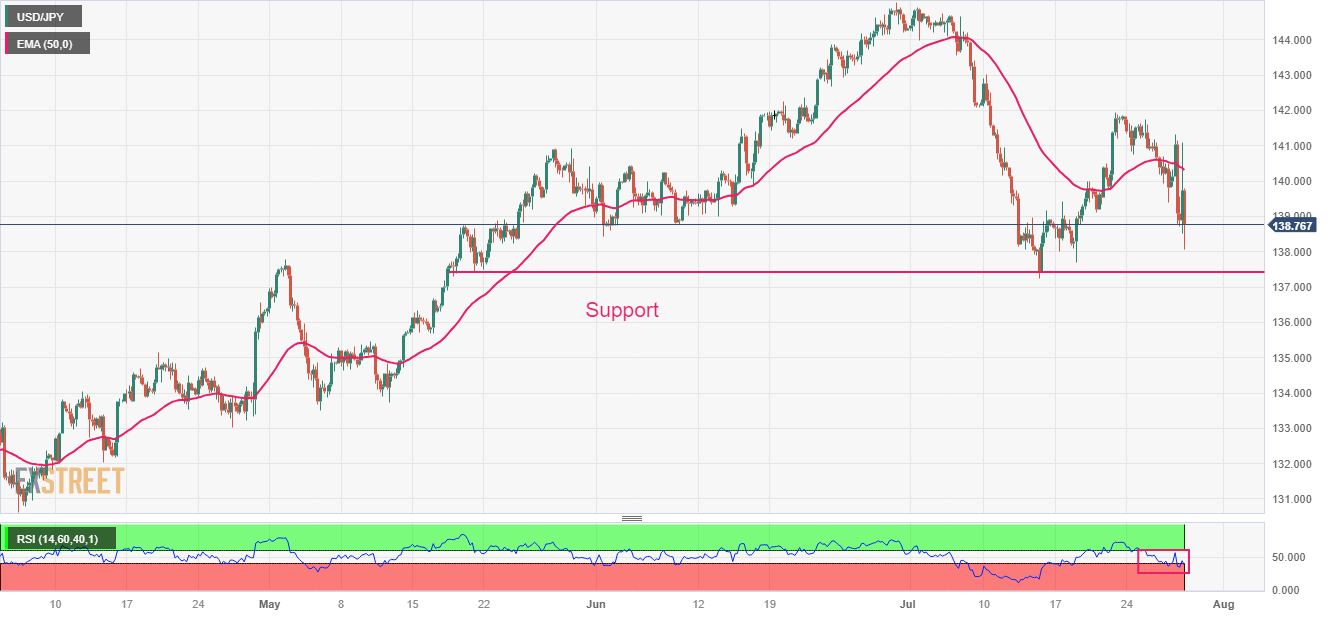
  • USD/JPY is declining towards the horizontal support which is plotted around 137.43.

The USD/JPY pair demonstrates wild spikes after the Bank of Japan (BoJ) allows more flexibility in Japanese Government Bonds (JGBs) yields but as usual, keeps interest rates unchanged. Changing dynamics in the Japanese economy as wages and corporate earnings have increased are allowing the central bank to gradually move towards tightening monetary policy so that the Japanese yen could be safeguarded against other currencies.

Before the policy announcement, Japanese Finance Minister Shunichi Suzuki hit the wires, citing that they are “closely watching fed and other central banks' policy decisions.” This indicates that expectations of an intervention to provide a cushion to the Japanese Yen are still open.

Meanwhile, the US Dollar Index (DXY) is juggling in a narrow range around 101.80 after a rally as the United Stated economy turned surprisingly resilient than expected.

USD/JPY is declining towards the horizontal support which is plotted from May 19 low around 137.43 on a four-hour scale. The asset has failed to sustain above the 50-period Exponential Moving Average (EMA) at 140.36, which indicates that the short-term trend is bearish.

A slippage below 40.00 by the Relative Strength Index (RSI) (14) would activate the bearish momentum.

Going forward, a decisive breakdown of May 19 low around 137.43 would expose the asset to May 16 low at 135.67 followed by May 11 low at 133.75.

In an alternate scenario, a decisive move above July 21 high at 142.00 would send the major toward July 10 high at 143.00. Breach of the latter would drive the asset towards June high at 145.07.

USD/JPY four-hour chart

Adblock test (Why?)


from "price" - Google News https://ift.tt/udE0mDK
via IFTTT

Thursday, July 27, 2023

As Russian oil crosses G7's price cap, US eyes soft enforcement - Reuters

WASHINGTON, July 27 (Reuters) - The Biden administration is poised to increase outreach to western trading houses, insurers and tanker owners to remind them to abide by the Group of Seven's price cap on Russian oil as the crude trades over that level, sources and experts said.

The approach reflects a desire by Washington to encourage buyers to adhere to the $60 per barrel cap imposed last December on sea-borne exports of Russian crude by the G7, the European Union and Australia in retaliation for Russia’s war on Ukraine.

The administration is expected to use "soft" tactics, instead of widespread threats of harsh enforcement on potential violators as that could upend energy markets, they said.

"The initial inclination on the part of Treasury is to be soft on it, not to come down like a hammer on tankers and tanker owners, to enforce, but enforce quietly with letters, phone calls," said a source familiar with the administration's thinking on the matter.

U.S. officials will likely increase communications with trading houses, tanker owners, insurers and others, reminding them that if western maritime services are used, attestations must be kept showing Russian oil was bought under $60, the source said.

A Biden administration source said such conversations with service providers about their requirements have been constant during the implementation of the caps.

"We’ve been having these types of conversations already and they will continue," the source said.

The price cap bans Western companies from providing services such as transportation, insurance and financing for the oil sold above the cap.

According to Reuters data, Russian Urals crude has been trading at or above the cap for nearly two weeks. Treasury uses a monthly average of prices to calculate the Urals price, which means it may be a while before the Russian oil price can be considered over the cap.

The Treasury's Office of Foreign Assets Control (OFAC) says individuals or companies who evade, avoid, or violate the cap could face civil or criminal enforcement actions, including fines, and that it will work with other countries to share information about evasion.

"We are hell bent on ensuring that evasions are not distorting the market," a senior U.S. Treasury official said.

'POLICY PICKLE'

The administration, however, is set to move slowly, wary of creating ripples in a market that could send rising global oil prices higher.

The administration is in a "policy pickle" because it does not want to come down too hard with enforcement threats and risk boosting global petroleum prices by interfering with the movement of oil, the source with knowledge of administration thinking said.

"They'll spook the service providers facilitating exports, they certainly don't want to do that."

High consumer energy prices are a political risk for President Joe Biden, who is seeking reelection in 2024.

The cap has always had two objectives: reducing Russia's revenues from oil exports, and ensuring that oil continues to flow to global markets. The administration insists the cap is effective.

Deputy Treasury Secretary Wally Adeyemo has recently spoken with countries with large shipping fleets and shipping trade, while Elizabeth Rosenberg, Treasury's assistant secretary for terrorist financing and financial crimes, has called protection and indemnity insurance providers, known as P&I clubs, to remind players of requirements related to Russian oil purchases, the administration source said.

COSTS TO RUSSIA

Another U.S. government source said that the Urals price is high because of recent deals to countries that are outside the cap.

Such sales, mainly to India and China, are expensive for Russia, the source said. Russia has to spend money on a ghost tanker fleet and other expenses to ship oil long distances instead of via pipelines mainly to Europe.

Adeyemo said last month the Russian central bank has guaranteed about $9 billion in a reinsurance scheme intended to replace western reinsurance, due to the price cap, money the Kremlin cannot invest in weapons to fight its war in Ukraine.

The State Department is "closely monitoring all vessels engaged in loading of crude oil and petroleum products from Russia, as well as potential evasion or non-compliance, including the use of deceptive practices to access coalition services for oil traded above the caps," a spokesperson said.

If Urals prices continue to climb above the cap, Washington could urge fellow G7 countries and the EU to raise the cap, but that would be a diplomatic and political undertaking that faces resistance from Eastern European countries and U.S. lawmakers.

Ben Cahill, an energy security and climate expert at the Center for Strategic and International Studies, agreed enforcement will proceed slowly.

"We could see stronger enforcement on the tanker fleet and the tracking of the ownership of vessels, better quality of attestation of paperwork," said Cahill. "But there won't likely be a dramatic change unless oil prices stay high for a while."

Reporting by Timothy Gardner Editing by Marguerita Choy

Our Standards: The Thomson Reuters Trust Principles.

Thomson Reuters

Timothy reports on energy and environment policy and is based in Washington, D.C. His coverage ranges from the latest in nuclear power, to environment regulations, to U.S. sanctions and geopolitics. He has been a member of three teams in the past two years that have won Reuters best journalism of the year awards. As a cyclist he is happiest outside. Contact: +1 202-380-8348

Thomson Reuters

Reports on oil and energy, including refineries, markets and renewable fuels. Previously worked at Euromoney Institutional Investor and CNN.

Adblock test (Why?)


from "price" - Google News https://ift.tt/9nGj1cK
via IFTTT

T. Rowe Price cuts 2% of workforce - Baltimore Sun

Unfortunately, our website is currently unavailable in your country. We are engaged on the issue and committed to looking at options that support our full range of digital offerings to your market. We continue to identify technical compliance solutions that will provide all readers with our award-winning journalism.

Adblock test (Why?)


from "price" - Google News https://ift.tt/KivCIUo
via IFTTT

Venezuela cuts back diesel prices to factories after complaints - Reuters

CARACAS, July 27 (Reuters) - Venezuela's government reduced an increase it had imposed at the beginning of the month on diesel prices to factories, after complaints from producers about the potential impact of the measure.

Venezuela's oil ministry this time set the price of diesel to factories at about 10 US cents per liter - payable in local currency, according to a resolution published on July 21 in the Official Gazette, which circulated on Thursday.

In early July, the ministry had set the diesel price to factories at 32 US cents per liter, prompting worry and complaints among companies amid rampant inflation and high costs for transporting essential goods by road.

After discussions between the private sector, PDVSA officials and several ministries, the government of President Nicolas Maduro revised the tariff, union representatives said.

Producers "insisted on the need to reduce the price of $0.32," said Luigi Pisella, president of Conindustria. "We think the response received to this request was positive."

The measure is now expected to allow Venezuela's state oil company PDVSA to charge factories for diesel at an adjusted price and in local currency, after three years of providing it for free as part of a set of measures related to domestic fuel supplies.

The government has taken measures in recent months to reduce heavy subsidies to public services and utilities, including water and electricity, which are mostly provided by state companies in a deficient or intermittent manner.

The new price does not apply to public transportation, which was excluded from the resolution.

Diesel production is insufficient to meet Venezuela's total demand due to the poor condition of its refineries, which operate at a fraction of capacity after years of lack of investment and delayed maintenance.

At the end of 2021, the government tried to adjust the price of diesel to the industrial sector to 50 US cents per liter, but the measure was not enforced.

Reporting by Deisy Buitrago; editing by Grant McCool

Our Standards: The Thomson Reuters Trust Principles.

Adblock test (Why?)


from "price" - Google News https://ift.tt/8eykOz4
via IFTTT

Companies' reluctance to roll back price rises poses US inflation risk - Financial Times

[unable to retrieve full-text content] Companies' reluctance to roll back price rises poses US inflation risk    Financial Times from...