Netflix, facing more competition globally in the streaming wars, has cut pricing in more than 100 markets worldwide — in some cases, chopping the price of monthly plans in half — to boost subscriber acquisition and retention.
The streamer has reduced prices in countries and territories across Asia, Latin America, Europe, the Middle East and Africa. Netflix is not reducing prices in North America or Western Europe, its most mature markets.
All told, the price reductions span more than 100 markets, according to research firm Ampere Analysis (see list, below). Those include Malaysia, Indonesia, Thailand, the Philippines, Venezuela, Nicaragua, Ecuador, Kenya, Iran, Croatia, Bosnia and Herzegovina, Serbia, Albania, North Macedonia, Slovakia, Yemen, Jordan, Libya, Slovenia and Bulgaria.
For example, in Venezuela, Netflix’s single-stream Basic plan is now $3.99/month (down 50% from $7.99 previously); the two-stream Standard plan is $5.99/month (vs. $10.99 before); and the four-stream Premium tier is now $7.99/month (vs. $13.99). In the Philippines, Basic dropped from ₱369 to ₱249/month and Standard was reduced from ₱459 to ₱399/month.
Netflix confirmed it has reduced pricing in “certain countries” but did not detail which ones. The Wall Street Journal earlier reported on the company’s price cuts in some international markets. “Members have never had more choices when it comes to entertainment. We’re always exploring ways to improve our members’ experience,” a rep said in a statement.
In Q4, Netflix gained 7.7 million new subscribers, growing its base in all geographic regions and blowing past the 4.5 million pickup it previously forecast, to reach 230.75 million worldwide as of the end of 2022.
“When you think about the pricing question… we want to make that spectrum even wider as we seek to serve more members around the world in trying to deliver appropriate value at those different price points,” Peters told analysts. “And we’re doing a good job expanding that range… There’s a bunch of people around the world in countries where we’re not deeply penetrated, and we have more opportunities to go attract them.”
Meanwhile, this year Netflix has begun to widen the rollout of its paid-sharing program through which it’s looking to convert unauthorized password-sharing accounts to paying customers. Netflix’s terms of service say customers may share their account only with members of their own household. Earlier this month, Netflix launched a “buy an extra member” option in Canada, New Zealand, Portugal and Spain -- and said it would begin blocking devices that it detects are trying to illicitly piggyback off someone else's account.
“This will not be a universally popular move,” Peters said on the earnings call. There will be “a bit of cancel reaction to that,” similar to what Netflix sees when it raises pricing. "Our job is to give them a little bit of a nudge and to create features that make transitioning to their own account easy and simple."
Here's the full list of countries where Netflix has reduced pricing, according to research firm Ampere Analysis: Afghanistan, Albania, Algeria, Angola, Bangladesh, Belize, Benin, Bhutan, Bolivia, Bosnia and Herzegovina, Botswana, British Indian Ocean Territory, Bulgaria, Burkina Faso, Burundi, Cambodia, Cameroon, Cape Verde, Central African Republic, Chad, Christmas Island, Comoros, Congo - Brazzaville, Congo - Kinshasa, Côte d’Ivoire, Croatia, Cuba, Djibouti, Dominica, Dominican Republic, Ecuador, Egypt, El Salvador, Equatorial Guinea, Eritrea, Ethiopia, Fiji, Gabon, Gambia, Ghana, Grenada, Guatemala, Guinea, Guinea-Bissau, Guyana, Haiti, Honduras, Indonesia, Iraq, Jamaica, Jordan, Kenya, Kiribati, Laos, Lebanon, Lesotho, Liberia, Libya, Macedonia, Madagascar, Malawi, Malaysia, Mali, Mauritania, Mauritius, Mongolia, Montenegro, Morocco, Mozambique, Myanmar (Burma), Namibia, Nepal, Nicaragua, Niger, Palestinian Territories, Panama, Papua New Guinea, Paraguay, Philippines, Pitcairn Islands, Romania, Rwanda, Samoa, São Tomé & Príncipe, Senegal, Serbia, Seychelles, Sierra Leone, Slovenia, Solomon Islands, Somalia, South Sudan, Sri Lanka, St. Barthélemy, St. Helena, St. Lucia, St. Martin, St. Vincent & Grenadines, Sudan, Suriname, Swaziland, Tanzania, Thailand, Timor-Leste, Togo, Tonga, Tunisia, Tuvalu, Uganda, Vanuatu, Venezuela, Vietnam, Wallis & Futuna, Yemen, Zambia and Zimbabwe.
Motorola recently unveiled the Defy 2, a rugged smartphone which also happens to be the first Android device with two-way satellite connectivity. Developed in collaboration with Bullitt, a company known for making rugged smartphones, the new smartphone will be sold as the Motorola Defy 2 in North and Latin America whereas it will be available with a slightly changed rear panel as CAT S75 in Europe, Africa and the Middle East.
The new phone from Motorola comes with the world’s first two-way satellite messaging app, called Bullitt Satellite Messenger, which lets users directly communicate with each other. Built on standards set up by the 3rd Generation Partnership Project (3GPP), the Motorola Defy 2 makes use of geostationary satellites to send text messages using the Bullitt Satellite Messenger. Apart from sending texts and 24×7 SOS assistance, users can also share their location and check-ins.
The app will initially look for Wi-Fi or a cellular network for sending messages, but if nothing is available, it will connect via satellite and should theoretically work as long as the user has a clear view of the sky. Users who receive messages from Bullitt Satellite Messenger will get a download link for their device and can check received messages for free, with the cost of text deducted from the subscriber’s plan.
Satellite connectivity will be available in Europe and North America at launch, with the company planning to expand to Australia, Africa, New Zealand, Latin America and other regions before the end of the year.
Currently, Bullitt is offering four plans – essential, everyday, premium and freedom. While the basic plan starts at $5 per month and lets you send up to 30 messages, the premium plan costs $30 that lets you send up to 400 messages a month. The company is also offering free SOS assistance for 12 months.
Motorola Defy 2 specs
The Motorola Defy 2 comes with a 6.6-inch 120Hz FHD+ LCD display protected by Gorilla Glass Victus. With up to 6 GB of RAM and 128 GB of internal storage, the phone runs on Android 12 out of the box and will be eventually be updated to Android 14.
Motorola has confirmed that the phone will have quarterly security updates for three years and emergency SMR updates for two more years. On the back, you get a 50 MP primary camera with an 8 MP ultrawide sensor and a 2 MP macro lens whereas the front of the phone sports an 8 MP shooter. All of this is backed by a 5,000 mAh battery with 15 W charging and Qi wireless charging support.
Advertisement
The rugged smartphone can operate for up to 24 hours in temperatures ranging from negative 30 degrees Celsius to 75 degrees Celsius, survives drops on steel sheets from six feet, can withstand humid environments like salt mist, comes with an antimicrobial coating with silver ions and can be washed with soap and disinfectants as well.
In North America, Canada and Latin America, Motorola Defy 2 will be available sometime in the second quarter of 2023, will cost $599 (approximately Rs 49,755) and includes a 12-month subscription to Bullitt’s Essential plan.
Currently available as Cat S75 for pre-order in Europe, the Middle East and Africa, the phone is priced at €599 and includes a three-month Bullitt Essential subscription.
For Ukraine, the year since Russia’s invasion has been one of widespread death, destruction and displacement, as millions had their lives changed forever. Americans got off easy by comparison, with most feeling the impact of the war only at the gas pump.
But the effect on Americans was far less than it was across Europe, where energy prices for driving and heating climbed much higher. Still, Americans have paid a price for the war, and for the sanctions that the United States and its allies imposed upon Russia after its invasion.
US gas prices shot up $1.48 a gallon, or 42%, to a record $5.02 between the day before Russia’s invasion a year ago and the record price reached on June 14.
That peak was short-lived — the national average price of gasoline, as tracked by OPIS for AAA, fell continually for 98 straight days starting right after that record was reached in June until September 20. On Friday, the one-year anniversary of the invasion, the national average stood at $3.39 a gallon, compared to $3.54 on the day the war started.
But even with the steady decline since that June record high, US drivers spent $528 billion on gasoline last year, up $120 billion from what they spent in 2021, according to OPIS. That works out to about $900 more per US household.
Last year’s total is nearly double the amount spent on gasoline in 2020, when stay-at-home orders and massive job losses in the pandemic’s early months crashed demand for gasoline and sent prices plunging. Even compared to pre-pandemic 2019, the amount spent on gas last year jumped $156 billion, or $1,200 per household on average.
Why prices shot up, then fell
A number of factors have coincided to bring prices steadily lower since then. Now, a year after the start of the war, crude oil prices on global markets and the retail price of regular gas across most of the United States are below pre-war levels.
And forecasts suggest they will stay that way going forward. OPIS expects the average price throughout the course of 2023 to come in around $3.45, down from $3.96 last year. Even some higher forecasts, such as one from Goldman Sachs, estimates an annual average of $3.87 this year.
To understand why they’re down, it’s important to understand why they went up so much and so fast.
Crude oil prices are determined on global commodity markets. And to some extent, those markets overreacted to the start of the war.
“The market’s reaction was due to uncertainty,” said oil analyst Andy Lipow. He said that those trading oil futures thought the global market would have to find a replacement for all the Russian oil when there wasn’t an alternative available.
But Russian oil shipments continued even with the sanctions, although they were redirected elsewhere. Instead of sending much of its oil and refined products to Europe, Russia sent them to countries like China, India and Turkey.
And the sanctions never completely shut down the shipments of oil to Europe, although a price cap limited the shipments and the amount that buyers in those countries would be willing to pay.
So the sanctions achieved the goal of reducing the revenue Russia got from oil sales.They also they allowed global prices to retreat from the June peak.
“There was a belief Russian production would be crimped. But its production is close to what it was a year ago,” said Tom Kloza, global head of energy analysis for OPIS.
In addition, the United States and its allies announced in March they would start releasing oil from their stockpiles of crude, such as the US Strategic Petroleum Reserve, putting downward pressure on prices.
Economic outlook also drove oil prices
Oil is traded globally in US dollars, and the strong dollar that benefitted from the Federal Reserve’s historic interest rate hikes helped to limit the effect of the price hikes on US consumers, even as drivers who pay in other currencies had to spend far more.
Few things take a bite out of gas prices like a recession, or even just the fear of one. People who lose their jobs don’t have to commute andpull back their spending on discretionary items like travel. Consumption falls, followed by prices.
A prime example of this took place during the Great Recession 15 years ago. The average price of a gallon of regular gas hit a then-record of $4.11 in early July 2008, according to OPIS data. Six months later, following the meltdown in financial markets, and massive job losses, it was down 61% to $1.62.
RIsing fears of a global and US recession roiled markets in late 2022, pushing down the price of oil futures. Fears of a US recession have receded recently, with very strong reports on US job growth and retail sales, but they’re not gone — particularly not with the Fed expected to continue raising interest rates.
Finally, while many of the restrictions on daily activity imposed during the pandemic have disappeared in the United States and Europe, China lockdowns in late 2022 hurt worldwide gasoline consumption, and with it global prices. China has since reopened but whether it stays open remains to be seen.
Price below pre-war levels
By the end of November, the national average price for a gallon of regular had fallen below the $3.53 average on Feb. 23, 2022, the day before the invasion. It has remained below that mark ever since, even though it’s up a bit from the post-invasion low of $3.10 a gallon in the week around Christmas. That is typically a time period that sees the lowest pump prices of the year.
Of course, the national average might not have much to do with what the stations near you are charging. There’s a wide variation in prices, with Western states, particularly California, paying much more because of a drop in refining capacity there and tougher environmental rules.
“It’s easy to say we’re not going to match last year’s prices,” said Kloza. “It might be a year when California is paying $6, and Texas is at $2.99.”
In 1971, three former students from the University of San Francisco set up the first Starbucks at Seattle’s Pike Place Market, selling fresh roasted coffee beans, teas, and spices from around the world. This was a relatively humble beginning for what is now the largest coffeehouse chain in the world.
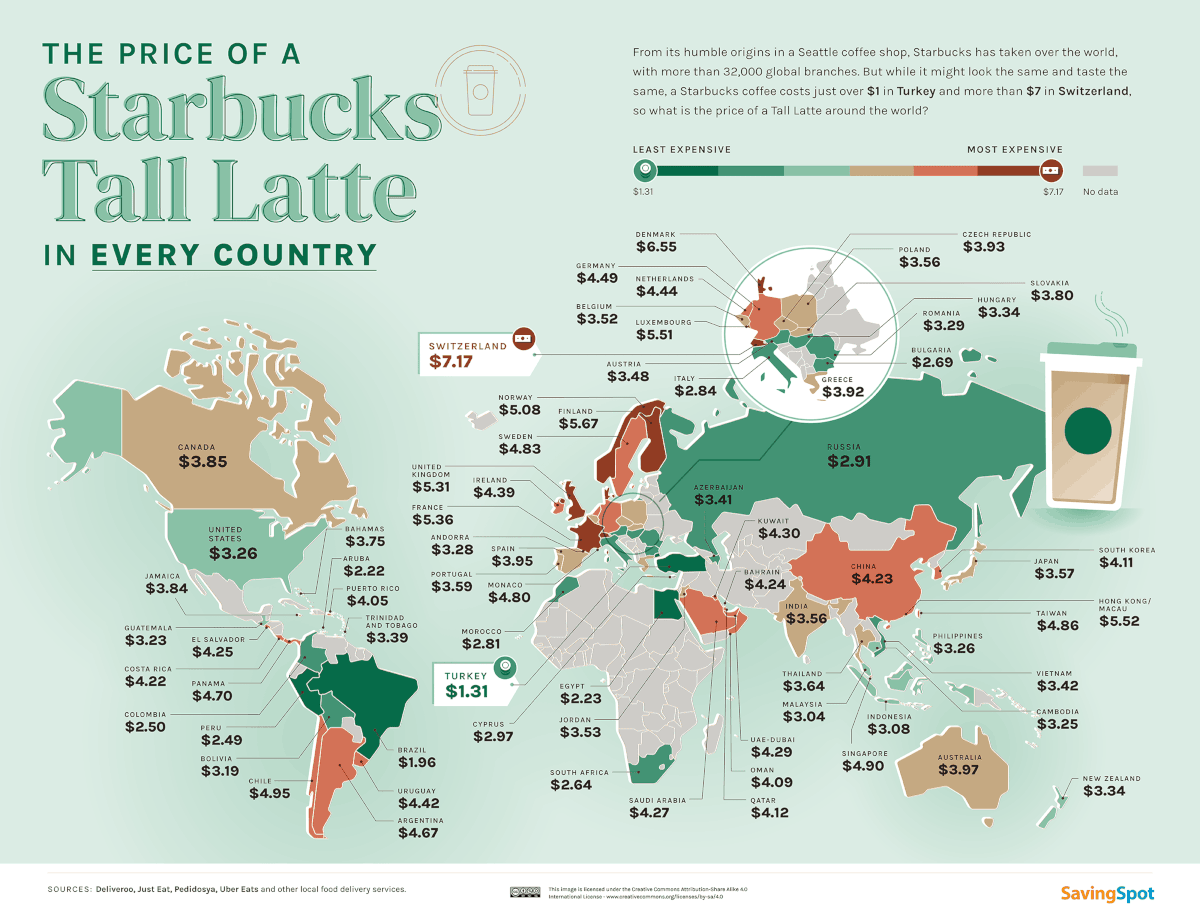
Today, Starbucks boasts 32,000 stores across 80 countries, second only to McDonald’s in the fast-food chain business. And like McDonald’s, the price of a coffee at Starbucks varies wildly depending on the country you’re in.
This map made by SavingSpot has the answer to which country has the most and least expensive Starbucks coffee, for those connoisseurs who want to get the most bang for their (Star)buck—or for those who want to examine relative cost and purchasing power.
Which Country Has the Most Expensive Starbucks Coffee?
The underlying data for this map uses a combination of sources, including delivery apps, Google Reviews, menu images, and desk research, all cross-checked to come up with the price of a Tall Latte per country (converted to USD).
Per their findings, the most expensive Tall Latte (12 oz) in the world can be found in Switzerland for $7.17. On the other hand, the same drink can be bought for a little over a dollar in Türkiye.
Here’s the full rankings of the “Tall Latte Index”:
Country
Tall Latte Price
Türkiye
$1.31
Brazil
$1.96
Aruba
$2.22
Egypt
$2.23
Peru
$2.49
Colombia
$2.50
South Africa
$2.64
Bulgaria
$2.69
Morocco
$2.81
Italy
$2.84
Russia
$2.91
Cyprus
$2.97
Malaysia
$3.04
Indonesia
$3.08
Bolivia
$3.19
Guatemala
$3.23
Cambodia
$3.25
Philippines
$3.26
United States
$3.26
Andorra
$3.28
Romania
$3.29
Hungary
$3.34
New Zealand
$3.34
Trinidad and Tobago
$3.39
Azerbaijan
$3.41
Vietnam
$3.42
Austria
$3.48
Belgium
$3.52
Jordan
$3.53
India
$3.56
Poland
$3.56
Japan
$3.57
Portugal
$3.59
Thailand
$3.64
Bahamas
$3.75
Slovakia
$3.80
Jamaica
$3.84
Canada
$3.85
Greece
$3.92
Czech Republic
$3.93
Spain
$3.95
Australia
$3.97
Puerto Rico
$4.05
Oman
$4.09
South Korea
$4.11
Qatar
$4.12
Costa Rica
$4.22
China
$4.23
Bahrain
$4.24
El Salvador
$4.25
Saudi Arabia
$4.27 (Iced Caffè Latte)
UAE-Dubai
$4.29
Kuwait
$4.30
Ireland
$4.39
Uruguay
$4.42
Netherlands
$4.44
Germany
$4.49
Argentina
$4.67
Panama
$4.70
Monaco
$4.80
Sweden
$4.83
Taiwan
$4.86
Singapore
$4.90
Chile
$4.95
Norway
$5.08
United Kingdom
$5.31
France
$5.36
Luxembourg
$5.51
Hong Kong/Macau
$5.52
Finland
$5.67
Denmark
$6.55
Switzerland
$7.17
The U.S. has the 21st-least expensive coffee in the world at $3.26 for a Tall Latte, making it an unusual combination of a high-income country with a low price. Usually, it’s more common to see countries with a “developing” or “low-to-middle income” status have cheaper Starbucks prices than higher-income countries.
The Price of a Tall Latte Relative to Income
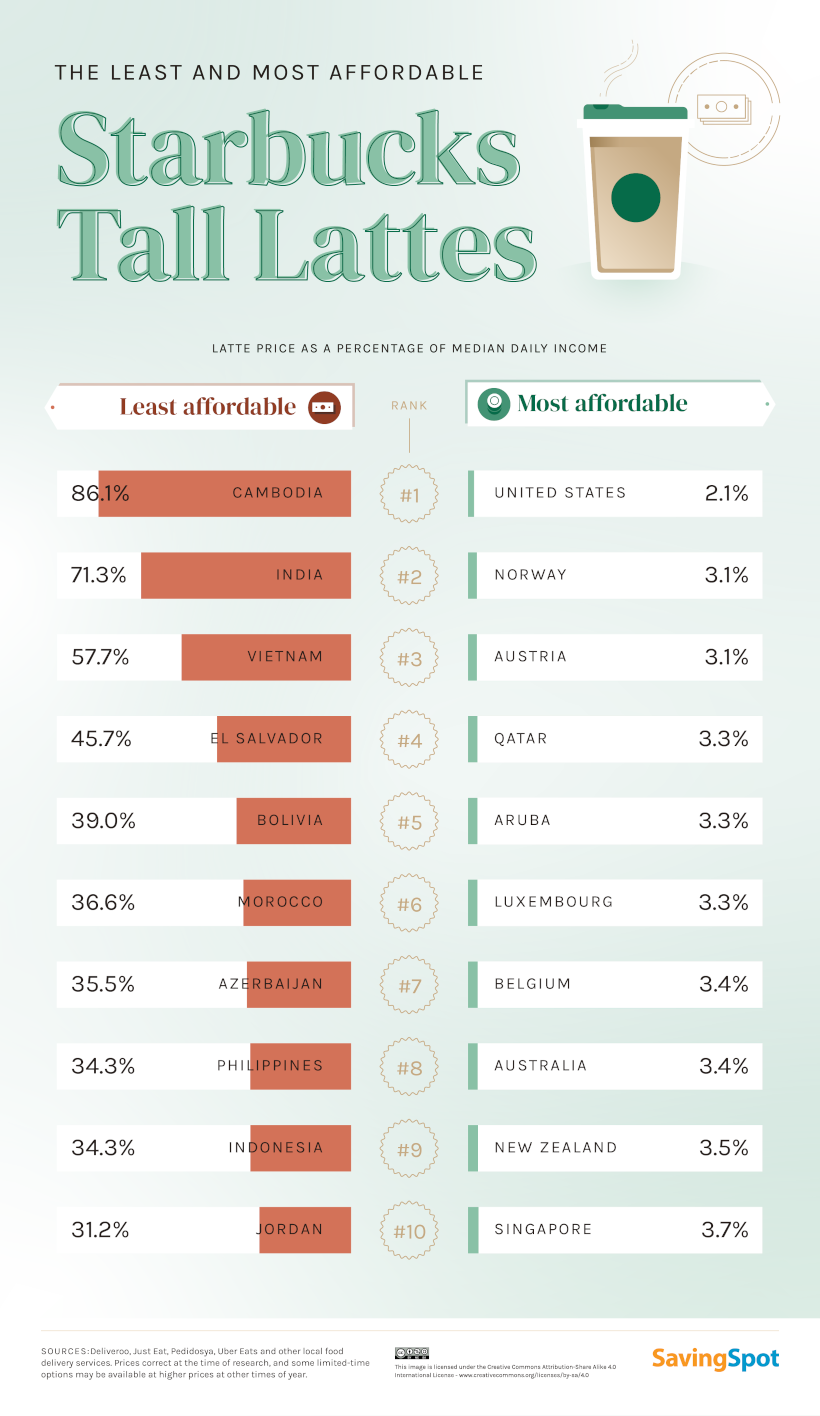
However, simply converting local prices to USD doesn’t give the most accurate picture of how expensive Starbucks is in a country. Taking purchasing power into consideration, here’s how the price of a Tall Latte measures as a percentage of a country’s median daily income.
In Cambodia and India, it would take more than 70% of the median daily wage to buy a Starbucks coffee. Other countries with relatively cheaper Tall Lattes in U.S. dollar terms include Indonesia, Morocco, and Bolivia—but these are still not the most affordable for local customers.
For a more broad-based view of Starbucks affordability, SavingSpot has also charted the price of a Tall Latte against each country’s per capita GDP. Countries placing higher than the trendline get relatively bad value at Starbucks, while those below the line can get more lattes with their average local paycheck.
Switzerland, Denmark and Luxembourg all have expensive Tall Lattes, even relative to their high-earning populations.
But countries like Chile, Panama, and Argentina have the worst of both worlds. Not only do they have more expensive lattes than higher GDP per capita countries like Canada, the U.S., and Australia, they do so at a fraction of the income.
What’s the Most Expensive Starbucks Item?
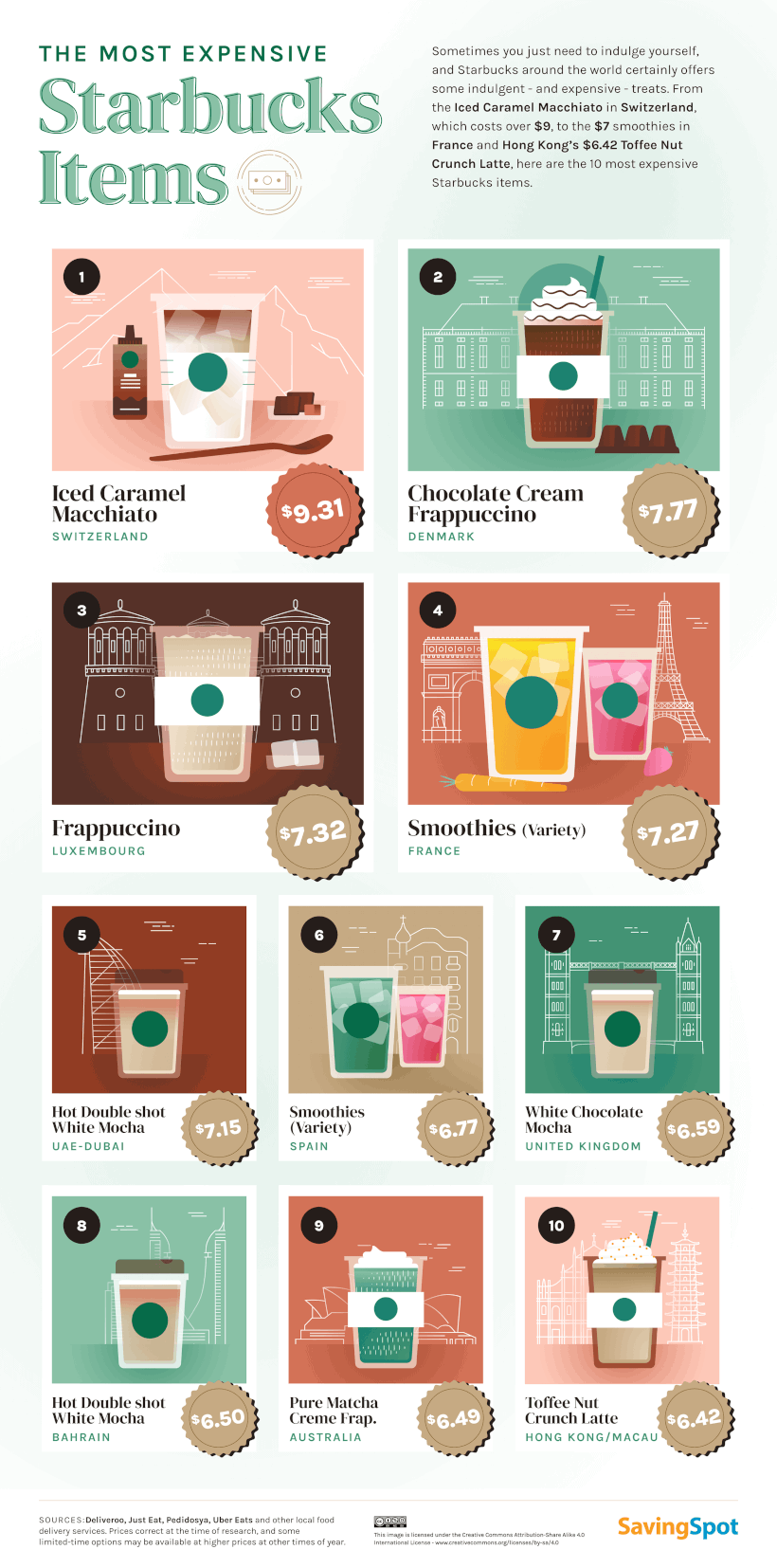
Based on SavingSpot’s findings, the Iced Caramel Macchiato in Switzerland is the most expensive Starbucks menu item in the world, coming in at a whopping $9.31 for a coffee with vanilla-flavored syrup and a caramel drizzle.
Denmark, Luxembourg, and France also have items well above the $7 USD price tag.
Whether those prices justify the quality of Starbucks coffee is a question best left up to the coffee aficionados, but for Starbucks, it’s a strategy that’s certainly helping the company’s earnings.
Still have questions about coffee? Check out From Bean to Brew which breaks down the complicated coffee supply chain.
This article was published as a part of Visual Capitalist's Creator Program, which features data-driven visuals from some of our favorite Creators around the world.
The price hikes are highest for bundled contracts when the mobile customer pays for both usage and the handset. Photo: Suzanne Plunkett/Reuters
Mobile customers are trapped in a Catch-22 situation between mid-contract price hikes and exit fees of over £400 to end their contract.
The “big four” mobile firms – EE, O2, Three and Vodafone – raise prices every April in line with inflation, plus an additional 3.9%.
Which? calculated that the average EE customer on a bundled contract would see an annual increase of £66.36, while the typical Three customer would see a hike of £56.40.
The same EE customer would face exit fees of £424.67 to leave a year early and Three’s customer would need to pay £379.46 to leave their contract.
EE, Three and Vodafone use Consumer Price Index (CPI) – leading to price increases of more than 14% this year, while O2 uses the higher Retail Price Index (RPI) measure, meaning some customers will face hikes of more than 17%.
As the price rises are often applied mid-contract, customers either have to accept them or pay exit fees to leave.
The price hikes are highest for bundled contracts when the customer pays for both usage and the handset.
Using the example of an EE customer who took out a 36-month contract for an iPhone Pro Max with unlimited data, Which? estimated the customer would pay an additional £105 for the handset over the next year due to the price increases.
It calculated that the Three customer with the same contract would pay an estimated £86 extra for the handset over the next year.
An average SIM-only customer with EE would see a potential annual increase of £46.20, followed by O2 and Vodafone customers who would see annual price hikes of £42.72 and £42.36 respectively. The average customer with Three would see the lowest annual increase of £25.20.
EE SIM-only customers would face the highest exit fees of £295.36 if they wanted to leave a year early, followed by Vodafone and O2 customers at £287.88 and £237.08.
Three customers face the lowest exit fees of £169.59 for leaving their contract a year early.
For O2 and most Vodafone contracts, only the airtime part of a contract is subject to inflation.
Which? is calling on providers to reconsider price rises – regardless of whether they are “transparent” – as consumers grapple with the ongoing cost of living crisis, and allow customers to leave their contract without penalty if charges are hiked mid-contract.
Rocio Concha, Which? director of policy and advocacy, said: “It’s hugely concerning that many mobile customers could find themselves trapped in a Catch-22 situation where they either have to accept exorbitant – and difficult to justify – mid-contract price hikes this spring or pay costly exit fees to leave their contract early and find a better deal.
“With many households struggling to make ends meet, it is completely unfair that people are trapped in this situation. Which? is calling on providers to act quickly and reconsider any price rises. Firms should cancel 2023 hikes for financially vulnerable consumers and allow all customers to leave without penalty if they face mid-contract price rises.”
An EE spokesperson said: “We strongly refute the research findings. SIM plans and handset plans meet different needs and handset customers get more benefits included. Currently, we don’t widely offer plans where customers pay separately for the handset and our customers pay their monthly fee for the services they get.
“We understand that price rises are never wanted nor welcomed, but recognise them as a necessary thing to do given the rising costs our business faces.
A Virgin Media O2 spokesperson commented: “We know that price increases are never welcome but, unlike other providers, we freeze the cost of device repayments and are only changing our airtime prices, meaning average bills will go up by an effective 10.0% or less than 10 pence per day. This is below inflation and reflects the fantastic value we provide for connectivity that is used almost constantly.”
Watch: Easy budgeting tips for when you leave home
Download the Yahoo Finance app, available forAppleandAndroid.
In the summer of 1998, Ken Hilderbrandt was contemplating buying a bigger boat — or a beachfront trailer on a wave-swept bluff in Montauk overlooking the Atlantic Ocean.
“There was a [for-sale] sign on the window, rotted off,” Hilderbrandt, 85, told The Post, recalling the dilapidated trailer sitting on a 1,972-square-foot lot of land within Montauk Shores, the former seaside campsite for working-class vacationers, locals and surfers. Hilderbrandt, who owns a jet-ski rental business in Bellport, saw the potential. Sure, it was a fixer-upper off a dirt road — but the million-dollar ocean views pulled him in like a riptide. The asking price was $150,000.
“I said, ‘That’s ridiculous.’ It was old. It needed to be gutted. I took a look inside, walked out here with him and said, ‘I’ll make you an offer — for $95,000.’ He said, ‘I want $96,500.’ So that was it,” Hilderbrandt said. He sold his boat and purchased the trailer.
The Post reported earlier this week that an off-market listing for this 800-square-foot oceanfront trailer within the Montauk Shores community was in contract to sell for a record-breaking $3.75 million.Stefano Giovannini for N.Y.Post
“Back then, you could rent them for $50 a month,” he said. A decade later, he tore down the trailer and erected a two-bed, two-bath modular home with a wraparound porch, marble countertops and laminate floors, investing around $100,000 in the remodel. Today, his humble 1,200-square-foot abode could command $60,000 as a three-month summer rental, enough to send one of his grandkids to college, he told The Post. He said he won’t even consider selling the property for under $5 million.
Though it bills itself as “Montauk’s best kept secret,” 65-year-old trailer park Montauk Shores is now a shabby-chic status symbol that’s dividing the local community. Hilderbrandt may drive a reliable Honda — but you’re just as likely to spot a $40,000 Mercedes SUV parked here. Deep-pocketed buyers are being lured in by its location in Ditch Plains — a surfer’s paradise spanning two miles of sandy cliffs and the most coveted waves on Long Island’s East End. This week, The Post reported that an off-market listing for an 800-square-foot oceanfront trailer located on Edgewater Drive was in contract to sell for a record-breaking $3.75 million.
It’s unclear who the buyer is in the deal set to close next month, but local residents said it’s the same unit musician Jimmy Buffett got into a bidding war over back in 2005. That’s when the mobile home reportedly sold for $430,000 to another buyer, though Buffett was said to have offered $30,000 more.
Montauk Shores home owner Ken Hildebrandt moved into the mobile home community more than 20 years ago and paid $96,500. Today, he says he can command up to $60,000 in three months for rent, and won’t even consider selling the property for under $5 million. Stefano Giovannini for N.Y.PostRetired NYPD detective Richard Pavese, 54, and his son, James Pavese. Pavese purchased the two bedroom home Montauk Shores in 2018 for $700,000. It was a life-long dream to own a summer home in Ditch Plains with his wife and kids.Stefano Giovannini for N.Y.PostMontauk Shores’ property comprises 152 individually owned lots and 47 leased sites totaling 199 homes — some scruffy-looking trailers, others tricked-out modular units.Stefano Giovannini for N.Y.Post
The trailer park’s previous highest recorded sale was in 2022 for $1.8 million. High rollers who’ve picked up modest homes here in recent years include Vitamin Water co-founder J. Darius Bikoff, hedge fund manager Dan Loeb and film producer Karen Lauder. The property comprises 152 individually owned lots and 47 leased sites totaling 199 homes — some scruffy-looking trailers, others tricked-out modular units. On-property amenities include a community clubhouse for residents to host parties and events, a heated swimming pool and a playground.
But longtime owners and locals remember Montauk Shores as it once was — a sanctuary for year-round surfing, ocean views and easy living. Starting in the late 1940s and ’50s, it was a tent campsite until the owners eventually filed for bankruptcy. In 1976, a group of residents and families purchased the property and started the Montauk Shores mobile-home park condominium, the first trailer-park condo association in New York State, according to its website.
“The people who are buying in there [Montauk Shores] are no longer firemen from New York City who want to go surfing on the weekend, they’re people who have a lot of money for a second home who say ‘I want to be right where the surf break is,'” Dave Rutkowski, owner of John’s Drive-In, which opened in 1967 on Montauk’s main drag, told The Post. “It’s wild to think that a trailer could ever sell for that much money.”
Though it bills itself as “Montauk’s best kept secret,” 65-year-old trailer park Montauk Shores is now a shabby-chic status symbol that’s dividing the local community.Stefano Giovannini for N.Y.Post
Residents say their new billionaire neighbors merely use the trailers as a changing room after a swim, leaving the units vacant during the off-season. And some say that all this cash is driving out the community feel and transforming the once funky surfer’s haven into a private-equity playground that’s a revolving door for entitled summer renters.
“When you read about the history of Montauk, it was a village of the workers. Now, they’re being priced out and pushed out,” Kathy Pare, a retired New York City teacher who moved to Montauk Shores with her husband, Chris, just after 9/11, told The Post. The couple, who used to park their camper in a nearby campground, bought a one-bedroom trailer for $175,000 in 2001.
Pare continued, “When we first moved here, it was a much tighter community. On the weekends we’d have parties, karaoke, hang out with our neighbors — now, since a lot of people moved out, we have a lot of renters. They can get loud at night because they’re there to party. You don’t get to know people for a long period of time. They don’t respect the rules.”
Her husband agrees.
“The people who are buying in there [Montauk Shores] are no longer firemen from New York City who want to go surfing on the weekend,” Dave Rutkowski, owner of John’s Drive-In, which opened in 1967 on Montauk’s main drag, told The Post.Stefano Giovannini for N.Y.PostTwo power linemen, John Cusmano (left) and Spencer McCarthy (right) take a lunch break at John’s Drive-In.Stefano Giovannini for N.Y.Post
“Personally, I don’t think it’s all that good. The people with money that are moving in don’t really want to be part of the community. We have functions all year long — barbecues, Fourth of July parties. Years ago, there were more residents partaking in these. The Vitamin Water guy, he doesn’t want to hang out with us. He doesn’t want to come to the barbecues up at the club house,” Chris told The Post.
Still, they emphasized that they’re “grateful” their home’s value has gone up and said that Montauk Shores remains a “great” place to live. Years after buying their trailer, the couple have erected a modular home of their own, with three bedrooms on the first floor and a studio in the attic with two queen-sized beds, a deck and an outdoor shower. The home can easily accommodate up to 12 guests, they said.
Locals recall Montauk Shores, which started as a camp site in the 1940’s and 1950’s, as being an easy-living community home to surfers relishing the waves in Ditch Plains.Stefano Giovannini for N.Y.PostThe tip of Long Island witnessed an uptick in sales in the early 2000s, after 9/11 spurred some to flee the city for a more laidback locale.Stefano Giovannini for N.Y.Post
Referred to by locals as “a drinking town with a fishing problem,” Montauk has been steadily losing its sleepy, blue-collar feel over the last couple of decades. The tip of Long Island witnessed an uptick in sales in the early 2000s, after 9/11 spurred some to flee the city for a more laidback locale. But the area’s image really started to shift with the 2008 opening of the trendy Surf Lodge nightspot. A hipster Manhattan party crowd soon descended on the town, overwhelming locals, and Ditch Plains Beach suddenly had cachet. In 2013, a limited-liability company headed by Bikoff purchased the beloved East Deck Motel in Ditch Plains, a family-run oasis for surfers and fishermen built in the 1950s, for $15 million, with the intention of building a private club for wealthy surfers, the East Hampton Star reported. The plan was eventually scuttled by angry residents and, in 2015, the motel went back on the market for $25 million. Now, the property just west of Montauk Shores has been subdivided into four lots, with owners listed under LLCs, according to property records.
By 2018, when retired NYPD detective Richard Pavese, 54, bought a home in Montauk Shores, prices had started to climb — but had yet to hit their current post-pandemic peak. He said he avoided a bidding war when picking up a two-bedroom, two-bath modular home for just under $700,000.
1 of 5
Advertisement
Mobile home units in Montauk Shores.Stefano Giovannini for N.Y.Post
Some residents have upgraded humble trailers to modular homes that can host up to 12 people.Stefano Giovannini for N.Y.Post
Advertisement
A mix of trailers and modular homes within Montauk Shores.Stefano Giovannini for N.Y.Post
Advertisement
“I had very close friends who were coming out here since the ’60s and ’70s. It was always my dream to have a place here for my kids,” Pavese, whose home is adjacent to Lauder’s, told The Post. “A few people have inquired [about buying our home], but it’s not something we’d entertain. It’s very placid here.”
Still, he said he isn’t bothered by his billionaire neighbors. After all, they’re hardly ever around.
“They don’t really stay here,” Pavese said. “They’ll stay for a weekend, a week — it basically revolves around fishing and surfing. They look like regular people. They go surfing and they come shower off. If someone has the money to spend, they’re going to spend it.”
And spend it, they are, leaving some old-school locals in a state of bewilderment.
Marshall, a Montauk local, at John’s diner.Stefano Giovannini for N.Y.PostLocals call Montauk “a drinking town with a fishing problem.” But it’s continued to lose its blue-collar feel in the last couple of decades.Stefano Giovannini for N.Y.Post
“We’re sitting here going, what the hell happened here?” a longtime Montauk resident named Marshall, who declined to give his last name, told The Post.
“It was always a pioneer place. When I grew up here there were 500 people. We knew everyone intimately; now, it’s more like corporate America. More rules, but not better rules. Our house may be worth more money, but if you sell it, where do you go? You sell, you got to leave and you can’t come back in,” he said.
“Montauk is now a brand. It’s the new-money surfers riding around on their electric bikes.”