[unable to retrieve full-text content]
EU Dims Hopes for a Price Cap to Contain Soaring Gas Costs Bloombergfrom "price" - Google News https://ift.tt/B90pUya
via IFTTT
[unable to retrieve full-text content]
EU Dims Hopes for a Price Cap to Contain Soaring Gas Costs Bloomberg
The wholesale price of used cars is falling off a cliff while the retail prices that car shoppers are paying is way up, suggesting dealers are making a killing while consumers are taking a bath.
Used car prices declined 2 percent from September in the first half of October and are down 10.3 percent from a year ago, according to The Manheim Used Vehicle Index published on Monday.
Wholesale used luxury car prices are down 13.5 percent while used sport utility vehicles are down 12.3 percent and pick-up trucks are down 8.4 percent.
Meanwhile, the retail price that car shoppers are paying for used cars has increased 7.2 percent since last year, according to the Department of Labor’s latest consumer price index.
The fact that dealers are paying less for cars than they were a year ago while shoppers are paying more suggests that dealers are holding onto the difference and are driving inflation in the used car market, economists say.
“Dealers don’t have to pass it on. They can make bigger profits,” Claudia Sahm, a former Federal Reserve banker and founder of Sahm Consulting, said in a message to The Hill.
“At the end of the day, inflation and how much prices go up – these are decisions made by businesses. Inflation does not just come down from on high,” she said in an interview. “You’re in a capitalist economy, so whether it’s a small business or corporation, they get to decide when they pass a price increase or a price decrease on.”
“The Fed knows that import prices are falling, producer prices have really decelerated overall, wage growth has slowed down some though there are still labor costs, but disinflationary factors will eventually show up in consumer prices,” she added.
Economist Dean Baker of the Center for Economic Policy and Research (CEPR) said the difference between wholesale and retail prices in the market for used cars “likely is in part margins, but also a lag.”
“If a dealer paid $5000 for a car that today would sell for $4500 in the wholesale market, they probably will still look to get a price that compensates them for the $5000 they paid. That might mean there is a month or two for prices in the retail market to adjust to prices in the wholesale market,” he told The Hill.
More broadly, however, economists have noted increasing profits during the pandemic.
“It is … important to remember that we had a large shift of income shares from wages to profit in the pandemic. We can argue whether this was due to the exploitation of monopoly power or simply an outcome of shortages created by the pandemic and the war [in Ukraine], but the shift to profits is undeniable,” Baker wrote in a recent blog post.
Mark Schirmer, director of public relations with Cox Automotive, which publishes the Manheim Used Vehicle Index, said he expects auto prices to decline in the short term, with retail prices following drops in wholesale prices, but that auto prices will remain elevated over the longer term.
“We still think that with new vehicle inventory still low, we’re not expecting retail prices or wholesale prices to crash, but we certainly expect for them to come down some,” he said in an interview with The Hill.
“We’re not expecting a huge correction. They’re going to stay historically elevated for a while,” he added.
The marked contrast in the directions of pricing trends in the used car market comes as the Federal Reserve is hiking interest rates in order to bring down inflation. Federal Reserve officials say that by increasing interest rates, they will bring down demand and that lower demand will bring down prices.
“In the United States, we … have a demand issue,” Federal Reserve chair Jerome Powell said during a press conference last week at which he announced another three-quarter percent rate hike. “We’ve got an imbalance between demand and supply, which you see in many parts of the economy. So, our tools are well suited to work on that problem.”
But some economists are asking the Fed for further details about how they expect these dynamics to work.
“Powell’s public remarks offer little insight into how he expects higher rates to tame inflation,” UBS economist Paul Donovan wrote in the Financial Times last week. That’s important because “today’s price inflation is more a product of profits than wages.”
“Companies have passed higher costs on to customers. But they have also taken advantage of circumstances to expand profit margins. The broadening of inflation beyond commodity prices is more profit market expansion than wage cost pressures,” Donovan wrote.
Commodity price increases, especially in the energy sector, are driving inflation at the international level. The United Nations Conference on Trade and Development says that current inflation “derives largely from cost increases, particularly for energy, and sluggish supply response” that has been “amplified by price-setting firms in highly concentrated markets raising their mark-ups.”
But at the national level, the Fed’s “demand issue” has economists looking at the labor market as well as consumer spending habits to predict when the central bank will stop raising interest rates.
“The most important argument against further rounds of aggressive rate hikes by the Fed was in the wage data. After seeing moderate growth in the hourly wage in both August and September, we got another moderate number for October. If we take the annualized rate over the last three months, it comes to 3.9 percent, that’s down from an annual rate of more than 6.0 percent last fall,” CEPR’s Baker wrote.
Kansas City Federal Reserve president Esther George said in an interview with National Public Radio (NPR) last week that excess demand in the economy is also due to extra household savings.
“We see today that there is a bit of a savings buffer still sitting for households, that may allow them to continue to spend in a way that keeps demand strong,” George told NPR. “That suggests we may have to keep at this for a while.”
Updated at 5:02 p.m.

Twitter users on Sunday flagged a tweet from the official presidential handle @POTUS that had President Biden touting “the most common gas price” in the country at $3.19, drawing attention to the fact that was lower than what the average consumer sees at the pump.
“Right now, the most common price at gas stations across the country is $3.19 per gallon. That’s progress,” Biden wrote.
The Tweet was flagged with the platform’s context feature, which allows readers to add “context they thought people might want to know.” The marker appears when the addition is rated helpful by other users.
“Biden is referring to the ‘most common gas price’ as oppose to the average gas price of $3.800 (11/6/22). The most common is the ‘mode’ gas price. Neither are wrong and politicians tend to reference the one that is lower. The mode diminishes high gas states from the equation,” the addition read, linking to a gas prices tracker from AAA and an article from The Wall Street Journal about why the most common price of gas is different from the average.
The context wasn’t a correction on Biden’s post, as the president made clear he was referring to “the most common price” for gas, but the flag drew attention to the notable discrepancy between the most common price and the average price.
It’s at least the second time the Biden White House has been flagged on Twitter since Elon Musk took over more than one week ago.
Last week, the White House deleted a tweet that credited Biden for an increase in Social Security checks for seniors after numerous observers pointed out the raise was a result of high inflation, which has been one his administration’s biggest struggles this year.
Twitter later added context below the tweet noting that the increase was due to the annual cost of living adjustment as part of a 1972 law that tied automatic benefit adjustments to the consumer price index, a key marker of inflation.
With the economy a top election issue heading into Tuesday’s midterms — among recession fears and high prices from inflation — the White House is angling to paint the administration’s impact on the economy in a good light.
But that proved to be problematic again last month when Biden in a speech said that “today, the most common price of gas in America is $3.39 — down from over $5 when I took office,” but fact-checkers were quick to clarify that the most common price for a gallon of gas was actually much cheaper when he took office, at $2.39, according to CNN.
/cloudfront-us-east-2.images.arcpublishing.com/reuters/AQDWAZRULBIVPJ7I6GZS32VARM.jpg)
SINGAPORE, Nov 7 (Reuters) - Oil prices fell more than $1 a barrel on Monday after Chinese officials on the weekend reiterated their commitment to a strict COVID containment approach, dashing hopes of an oil demand rebound at the world's top crude importer.
Brent crude futures dropped $1.20, or 1.2%, to $97.37 a barrel by 0227 GMT, after hitting as low as $96.50 earlier. U.S. West Texas Intermediate crude was at $91.24 a barrel, down $1.37, or 1.5%, dropping to a session-low of $90.40 a barrel earlier in the session.
"Oil prices dropped sharply as the Chinese officials vowed to stick to the COVID-zero policy while infected cases climbed in China, which may cause more restrictions measures, darkening the demand outlook," CMC Markets analyst Tina Teng said.
A jump in the U.S. dollar is also weighing on oil prices, she added.
Four Federal Reserve policymakers on Friday indicated they would still consider a smaller interest rate hike at their next policy meeting despite strong jobs data.
Brent and WTI rose last week, up 2.9% and 5.4%, respectively, as rumours of a possible end to stringent COVID-19 lockdowns sent China's stock markets and prices of commodities higher despite the lack of any announced changes.
However, at a news conference on Saturday, health officials said they will persevere with their "dynamic-clearing" approach to COVID cases as soon as they emerge.
Trade data from the world's No. 2 economy later on Monday could show further cooling in exports as global demand continued to soften.
"The market is still dealing with signs of weakness in oil demand from already high prices and the weak economic backdrop in developed markets," ANZ analysts said in a note, adding demand in Europe and the United States have fallen back to 2019 levels.
"We now expect global demand in Q4 2022 to grow by only 0.6 mb/d (millions of barrels per day) from the same quarter last year and to moderate next year."
Oil prices are underpinned by expectations of tighter supplies as the European Union's embargo on Russia's seaborne crude exports will start on Dec. 5 while refineries worldwide are ramping up output to meet strong diesel demand.
U.S. oil refiners this quarter will run their plants at breakneck rates, near or above 90% of capacity, while China's largest private refiner Zhejiang Petroleum and Chemical Co (ZPC) is raising diesel output.
Kuwait Integrated Petroleum Industries Co (KIPIC) said on Sunday the first phase of the Al-Zour refinery has started commercial operations, according to state news agency (KUNA).
Our Standards: The Thomson Reuters Trust Principles.
The US Dollar collapsed on Friday after the US Nonfarm Payrolls report for October showed the world's largest economy created more new jobs than expected, but also flashed signs of a slowdown with a higher Unemployment Rate and lower wage inflation. This enabled the euro to shoot higher as the following technical analysis will show.
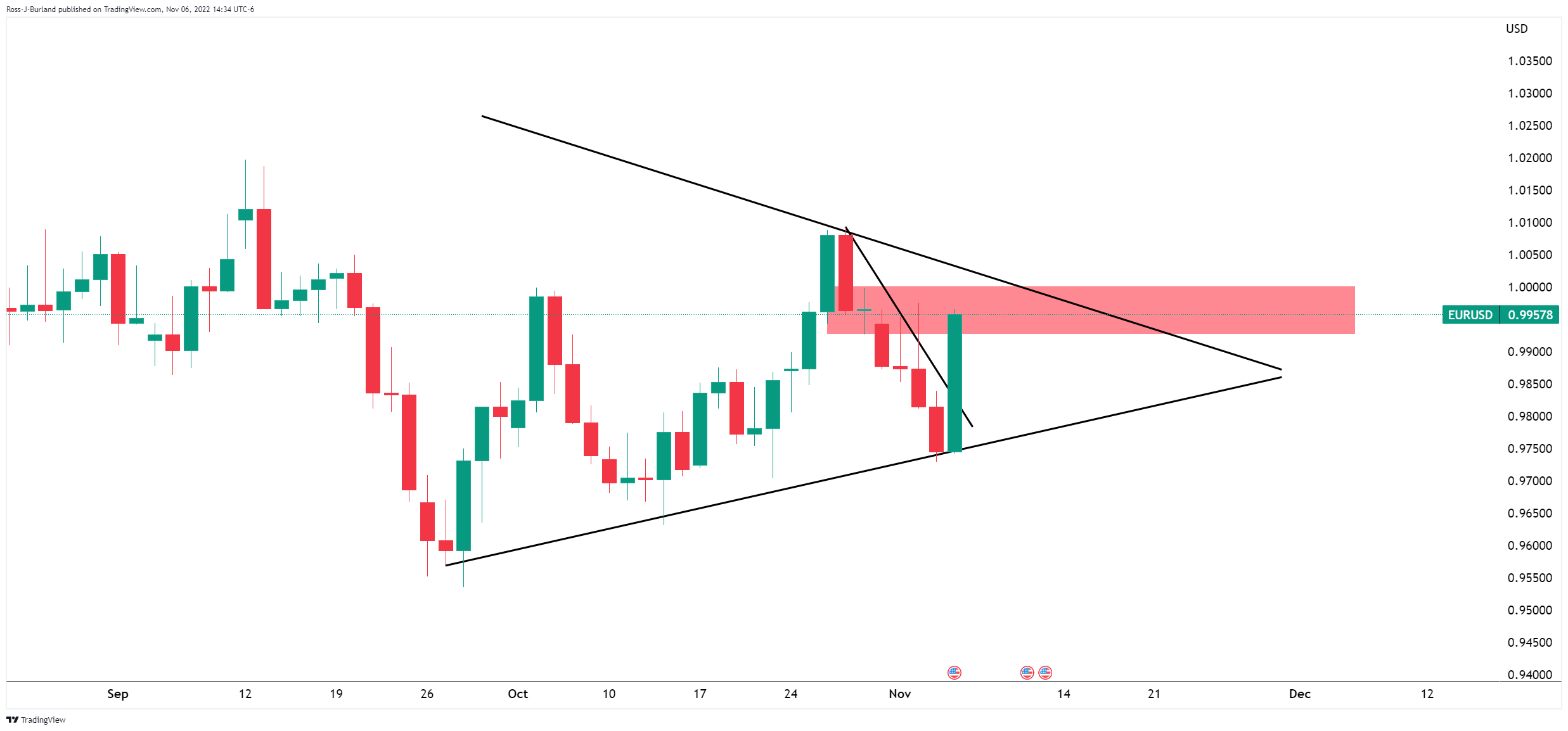
EURUSD is coiled on the daily chart having spiked into a 3key area of resistance below parity that bears will be looking to hold at the start of the week. A move into the impulse could be on the cards as the following hourly chart shows.
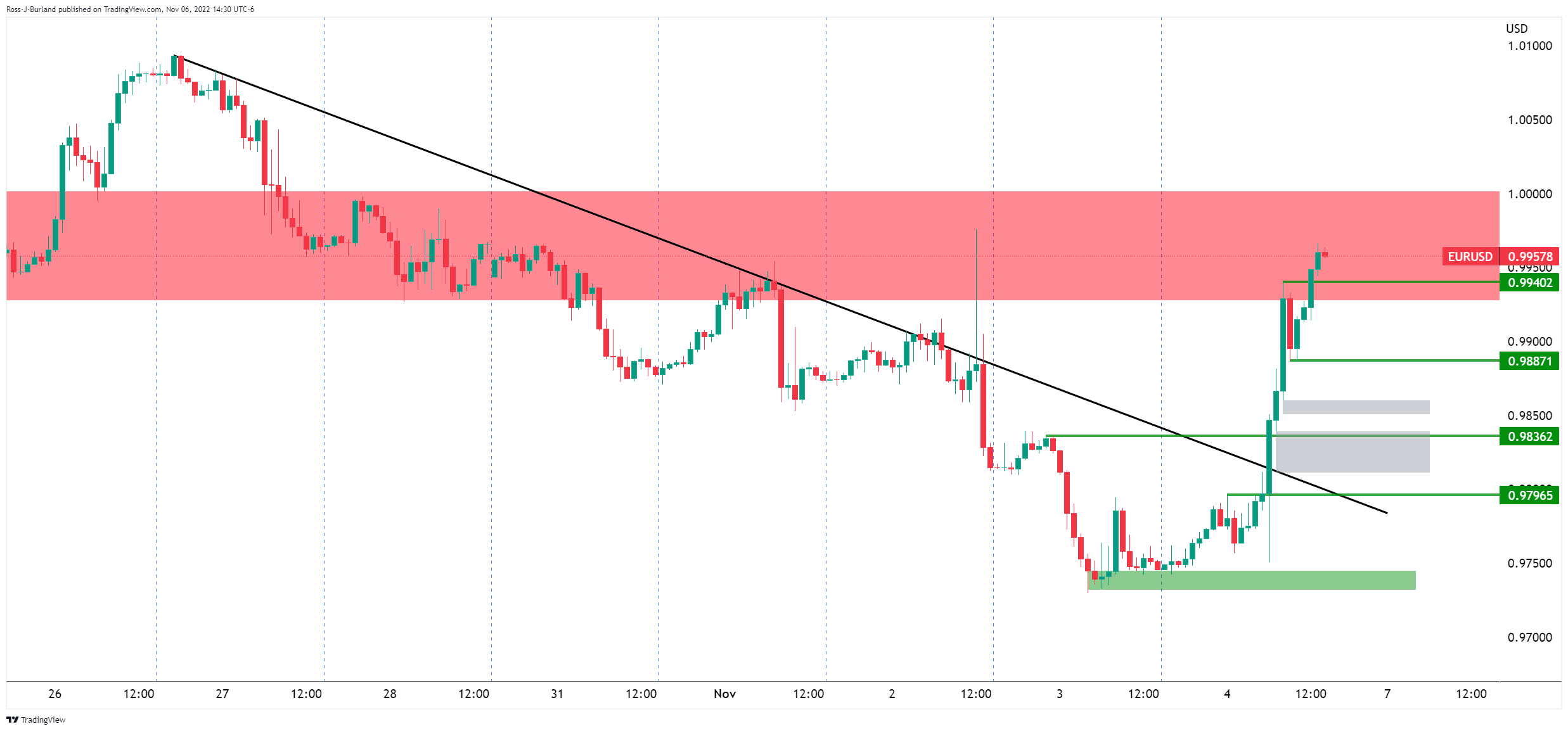
The price left behind a number of price imbalances on the impulse and would be expected to return into the move over the forthcoming sessions. 0.9880 will be a key support for the immediate future in that respect.
NFTs can be fixed-priced or sold during an auction. However, creators should consistently sell to demonstrate a proof-of-concept to boost the NFT’s floor price.

Early in 2021, markets for nonfungible tokens (NFTs) started to gain some notoriety, and by the end of March 2021, this new market for digital assets had a total lifetime traded volume of about $550 million. Any digital asset can be an NFT including collectibles, artwork, video game characters, virtual world objects and digitized sports.
A blockchain, often one on the Ethereum network, is where an NFT’s ownership is recorded. However, the sale of this digital asset will result in ownership transfers and the blockchain recording of the crypto payment received. This isn’t to say that NFTs and cryptocurrencies are the same. In general, one of the fundamental properties of cryptocurrencies and fiat money is fungibility or interchangeability, whereas the nonfungibility characteristic of NFTs makes them valuable.
This article will discuss how to price NFTs with profitability, what makes NFT’s floor price go up, how to know if your NFT is valuable or not and how much you should charge for an NFT.
As artists in the Web3 space begin their NFT journey, they may frequently find themselves considering the vital question: “How does one price their art?” or “what is the best strategy to sell NFTs?” Although there are no fixed strategies to price nonfungible tokens, NFT sellers may choose to sell them at the listing price in a secondary marketplace. Alternatively, they may conclude the sale at a price that a buyer is willing to pay, called buyer price.
Regardless, being the creator, you have full authority to choose the best NFT pricing strategy. However, if you set your price too high, you risk never being able to sell that item, and if you select your price too low, it will be more challenging to raise it gradually. So here are a few things to consider to determine how much you should charge for an NFT or how to price your NFT art pieces.
Different kinds of costs are implied while producing and selling NFTs, including creation costs such as the wages of a professional 3D artist if one needs to learn how to create nonfungible tokens themselves. Using a zero code tokenization platform like TokenMint might be an alternative option for those with a non-software development background.
Other costs involve minting costs that may vary with the fluctuating gas fees, marketplace fees for minting or listing nonfungible tokens, selling fees charged by NFT marketplaces and the cost of marketing nonfungible tokens.
A rare NFT is worth more than a common one because an asset’s supply and type determine if it is rare or not. For instance, a limited edition NFT may be priced higher than one with multiple copies. Similarly, a physical painting may be worth more than its digital image(s) available. In terms of functionality, utility tokens are more valuable because owners may use them to buy goods and services. Therefore, you must consider your clients’ needs when determining the price for these utility NFTs.
The NFT ecosystem is still developing and has enough room to grow. As consistency is one of the most crucial factors to accomplishment and success, the same goes for the nonfungible token artists, i.e., they need to display passion and trust in the process.
To make a reputation in the NFT industry, one needs to market their artist’s name to the masses via different mediums such as Twitter, Discord and Telegram to familiarize people with the artistic journey. Additionally, working with other platforms, artists and businesses in the nonfungible token space may open further opportunities to sell your work at the right price.
Having an idea that, “if Beeple can sell his Everydays artwork for an astounding $69 million, why can’t I?” is good for motivation. However, overconfidence can be misleading as you may not garner the same sales that another artist in the space achieved. So, what makes the NFT floor price go up? In order to raise the floor price of an NFT, make some consistent sales to establish a proof-of-concept.
The floor price is the lowest price for NFT collections and is constantly updated. A nonfungible token’s floor price is initially determined during the minting process by the NFT project’s founder or creator. Then, holders who list their work on a secondary market, once the minting procedure is complete, set the floor price. That said, the floor price for an NFT project rises as it gains popularity. And, proof-of-concept is evidence that intends to assess an idea’s viability or confirm that it will work as intended.
NFT artists can sell their artwork at marketplaces like OpenSea and Rarible, but their work is considered valuable everywhere, regardless of where it was minted. Therefore, leveraging multiple platforms with consistent prices for your work may be an ideal option to stay active and gain maximum traction.
For NFTs, unlockable content creates utility for owners. The artist can enhance the NFT’s real-world worth by creating unlockable content outside of the digital token. There is a setting for unlockables when configuring nonfungible tokens. Unlockable content is the hidden content to be viewable by NFT owners only.
Redeemable discounts, thank-you notes, physical objects like signed products and high-resolution video clips are all examples of unlockable content on nonfungible tokens. This strategy aids NFT sellers in building brand equity and selling their work at competitive prices.
The first step to successfully selling and pricing your NFTs is to understand the industry, blockchains used in NFT development, marketplaces for nonfungible tokens, common types of NFTs already sold by artists in the space and their typical price range. The next step is to choose an NFT marketplace that suits your goals and determine the creation, minting, service and selling costs before defining your token’s unique value proposition. So, can you price an NFT at any price?
Being a creator, you can price an NFT at any price you find suitable. However, understanding what makes your nonfungible tokens unique from the competition is critical to charge a higher price for your NFTs and attract more buyers if you have a distinct and appealing value proposition. Then, research the ways to sell NFTs. The techniques you can use to sell your nonfungible tokens depend on your preferences.
NFTs can be sold utilizing two most common methods: at a fixed price or an auction, where nonfungible tokens are offered for sale on the open market. Fixed price can be set up for NFTs during the minting process or if you want to test the market, choose an auction in which your NFT is won by the bidder who makes the highest payment at the end, often called an English auction.
However, one can opt for a timed auction, a particular kind of English auction in which an NFT is up for bid for a predetermined length of time, with the highest bidder winning at the end. Additionally, a dutch auction is another option available; it is a decreasing-price auction in which the price keeps declining until your NFT is purchased. If NFT sellers want to earn revenue each time their work is sold, they can choose the royalties option. Finally, set a fair price for your NFT after considering the above-mentioned substitutes.
Nonfungible token sellers can sell crypto art or NFTs on OpenSea by following the steps below:


Marketing is at the heart of selling nonfungible tokens like any other product. So, if you are wondering why your NFT is not selling, it might be due to a lack of awareness among the nonfungible tokens community. But, how hard is it to sell an NFT?
Every artist has their own personal preferences: Some choose to be publicly visible, while others like to remain anonymous. However, to raise an NFT project’s profile, informing buyers of your professional background, including name, experience with blockchain technology and crypto art or other nonfungible tokens, is of paramount importance.
So, what kind of NFTs sell best? Although there is no definite answer, nonfungible tokens with a solid presence on different social media channels and displaying clear roadmaps may sell better than others. For instance, if an artist frequently tweets about their digital artwork and joins conversations about NFTs, it will help them build a brand and attract people to buy their work.
Alternatively, an attractive website listing your NFT collection with an accurate description will indicate genuineness to the community and help convert website visitors to actual buyers. However, avoid under-promising or over-delivering to build customer confidence in your work.

Apple's newest iPhones, the series 14 models, come with better displays, cameras, and satellite messaging, among other features and updates. But depending on where you live, they also may come with a higher price tag.
While some analysts projected that Apple might increase the price of its latest iPhones across the board due to continued supply chain challenges and inflation, potential buyers in the U.S. and China saw no increases compared to the series 13 models.
But for consumers in markets like the U.K., Japan, Germany, and Australia, the newest models also came with significant price increases.
For example, the base iPhone 14 model starts at $799 in the U.S., the same price that the company charged for the iPhone 13 at its release last year.
In the U.K., the base iPhone 14 costs £849, or roughly $975. The base iPhone 13 was priced at £779, an increase of £70 or roughly $80.
That price difference only increases with the more enhanced models. For example, the iPhone 14 Pro Max in the U.K. is £150 more expensive than the equivalent last year's model.
The reason Apple took the step to increase the price of phones in those markets has to do with currency fluctuations.
"Essentially every currency around the world has weakened against the dollar," Apple CFO Luca Maestri said on the company's fourth-quarter earnings call with analysts last week. "The strong dollar makes it difficult in a number of areas. Obviously, our pricing in emerging markets makes it difficult, and the translation of that revenue back into dollars is affected."
While Apple reported that its revenue increased 8% in the quarter to $90.15 billion, Apple CEO Tim Cook told CNBC last week that the company would have grown "double-digits" if not for the strong dollar.
"The foreign exchange headwinds were over 600 basis points for the quarter," Cook told CNBC's Steve Kovach. "So it was significant. We would have grown in double digits without the foreign exchange headwinds."
Foreign currency exchange is "a very significant factor that is affecting our results, both revenue and gross margin," Maestri said. Apple does hedge against its currency exposures "in as many places as possible around the world," he said, but those sorts of protections do start to reduce as the company needs to continue to buy new contracts.
But Apple also examines the foreign exchange landscape when it launches new products, Maestri said, which led to these most recent price increases.
"In some cases, for example, customers in international markets had to ... they saw some price increases when we launched the new products, which is not something that, for example, U.S. customers have seen," he said. "And that's unfortunately the situation that we're in right now with the strong dollar."
While recent currency fluctuations versus the U.S. dollar are causing some international buyers to pay more for an iPhone, there have been instances where Apple instead absorbed those costs.
In 2019, when the U.S. dollar also saw a rise in value compared to other currencies, Apple adjusted foreign prices in some markets and reset them to near or the same as they had been in local currencies a year prior.
However, the reason Apple did that was due to a decline in sales as a result of the price increase. For example, in Turkey, where the local lira had fallen 33% against the dollar in 2019, Apple's sales were down $700 million.
"We've decided to go back to [iPhone prices] more commensurate with what our local prices were a year ago, in hopes of helping the sales in those areas," Cook told Reuters in an interview at the time.
But in 2022, Apple says it has not seen any drop off in demand in those markets. Maestri noted that it saw double-digit growth in India, Indonesia, Mexico, Vietnam, and other countries even in their respective reported currencies.
"It's important for us to look at how these markets perform in local currency because it really gives us a good sense for the customer response to our products, the engagement with our ecosystem, and in general, the strength of the brand," Maestri said on the earnings call. "And I have to say, in that respect, we feel very, very good about the progress that we're making in a lot of markets around the world."
The U.S dollar has also risen steadily against the Chinese yuan over the six months, but there have been some signs that demand for the new Apple iPhones in the country might be weakening. While Maestri said Apple saw new September quarter records in Greater China, a recent report from Jeffries said that China sales of the four new iPhone 14 models over their first 38 days of being sold are down by 28% compared to the iPhone 13 models over the same period of time.
Here are some other comparisons of the prices of the base iPhone model between the 14 and 13 series:
Australia:
Japan:
Germany:
Apple isn't the only company acknowledging the impact that currency headwinds are having on its business and pricing decisions.
McDonald's reported that currency dragged down its revenue by 7 percentage points, accounting for its 5% year-over-year decline in sales – which would have increased by 2% without the currency impact. With 60% of its sales coming from outside of the U.S., "Obviously, we're translating those sales back into less U.S. dollars," CFO Ian Borden said on the company's earnings call last week.
At P&G, the currency hit keeps getting bigger. The consumer products company reported a 6% decline in net sales due to "unfavorable foreign exchange," which followed 3% and 4% negative currency impacts in each of its previous two quarters. The company had to raise its forecast for the exchange rate impact this year to $1.3 billion, with CFO Andre Schulten saying on the company's earnings call last week, "Foreign exchange has continued its strong move against us."
James Quincey, CEO of Coca-Cola, which makes approximately 80% of its earnings outside the U.S., said the dollar has been a high single-digit headwind this year. "It's likely to be a big headwind like that next year," Quincey said on CNBC's "Squawk on the Street" last week.
Coca-Cola, like Apple, has looked to offset some of the currency headwinds by raising prices, something it said it expects to continue to do as the U.S. dollar shows little signs of waning. "We are expecting pricing to be ahead of normal next year on top of what's happened this year," Quincey said.
So far, Coca-Cola has not reported demand dropping as a result of the higher prices, but Quincey did say there are some potential consumer concerns on the horizon.
"We do see our consumers are beginning to respond in a traditional way they would in a recession; delaying discretionary and high-ticket discretionary items and perhaps going to more private label or discount dollar channels," Quincey said, noting "some effects of reduction of purchasing power out there in the marketplace."


