[unable to retrieve full-text content]
UK Broadband Prices May Jump More Than 25% if Inflation Persists Bloombergfrom "price" - Google News https://ift.tt/TqoWKNy
via IFTTT
[unable to retrieve full-text content]
UK Broadband Prices May Jump More Than 25% if Inflation Persists Bloomberg
How do you define a woman? How fast will you cut taxes and red tape? How will you "suppress" Scotland's first minister? Will you abolish speed limits?
Questions from the Conservative Party members through their summer leadership campaign have been varied, but seem to reflect less concern than the population at large about the rising cost of energy.
Tory card-carriers are less likely to be the kind of people who are already unable to pay last April's 52% increase in the price cap on household fuel, and have no chance of paying the 80% increase being introduced in less than a month.
But such problems are mounting fast. For Citizens Advice, the usual winter worries about fuel bills have become a feature of summer. The call on food banks is sharply up.
Energy utility companies are crying out for a plan from government. They know they're in the front line of potential consumer revolt, and the harm may not just be reputational but financial, if they are left carrying a tonne of bad consumer debt.
Business does not have the protection of price caps. The clamour for help comes from varying sectors of the economy, and will surely become more acute as the rollover to new contracts is typically due in October.
David Hunter, an energy analyst with Schneider Electric, tells me that the prices being faced are eye-watering: some small firms are putting off a decision because they can't see how to pay the higher bills, or because they hope for something better.
But suppliers are also nervy: their offers are sometimes being quickly withdrawn when wholesale prices soar.
Scotland's licensed trade warns of pubs and restaurants closing at least for this winter, because they can't afford heating, cooking and food ingredient costs.
Six of the UK's biggest pub operators warned this week of many more permanent closures, with some facing costs up 300% and the average energy bill up around 150%.
One rather crude index of the six main inputs for beer, from grain to aluminium, with fuel for farming and transport costs, suggests brewing faces 62% inflation.
The licensed trade relies on people having disposable income for discretionary spend, and that's precisely what households are cutting back.

Whisky distillers have had a good run of late, including a strong exporting first half to 2022, but they are also facing pressure from rising costs.
Some are protected for now by hedging contracts signed before this year, but where they're not, their trade body says costs have doubled in a year, with expectations of a further 50% rise next year and as much in their shipping bills.
The quarterly survey from Scottish Engineering, with 143 respondents, has weighed in today with a similar picture: output and the order book remain positive, and more than half of those in the trade body's survey are protected by hedging strategies on energy.
But of those that are not, the average multiple on their energy bills has been a staggering 3.6-fold.
Chief executive Paul Sheerin cites one small, successful exporting company, handling tensile steel, that has a full order book through to next year, but with a five-fold increase in energy bills, its managers reckon they have a duty to seek advice on going into voluntary liquidation.
So what can be done?
Reducing energy use is one option where Britain is lagging its neighbours, including turning down thermostats on heating, turning them up on air coolers, and improving insulation.
EU members committed in July to reduce demand for gas by 15%. Germany is doing so with closure of swimming pools and showers, with lower office temperatures when autumn bites, turning lights off in shops, advertising overnight and floodlights on public buildings.
The cutbacks are already having an impact. The EU aimed at getting its storage capacity up to 80%, and with a squeeze on consumption, it has hit that target ahead of schedule. Lightening its grip on the market's demand throttle has seen wholesale prices subside by around a third in the past few days, from staggeringly high levels to merely alarmingly high multiples of the pre-crisis price.

Another option is rationing by means other than price - though this may become a necessity more than an option. Germany is preparing a plan that won't cut off households, but will see some industries required to shut down temporarily if gas runs low.
It's also preparing a list of those industrial users that will get a ration because they are deemed essential.
Liz Truss, the likely next British premier, was asked this week if rationing will come to Britain. Not on her watch, she said. But those who know the energy market say it's not for her to say, and misleading for her to promise: it depends on supply, which Downing Street cannot control, while Britain is partly dependent on imports.
Option three is a boost to household income, either through tax cuts or grants. While Liz Truss has emphasised tax cuts, or at least a reversal of the National Insurance increase earlier this year, and abandoning the rise in corporation tax, neither is much use for households below the tax threshold or companies that aren't making profits.
The green levy on bills, which she wants to remove, isn't required while renewable power users are selling power at very high rates, so the promise is reckoned by the Institute for Fiscal Studies to come to an average £11 saving over the next three months.
The foreign secretary, until Monday at least, is widely expected to have to reverse her opposition to what she calls "handouts", and her change of tone on the subject has done a modest amount of preparation for that U-turn.
Boosting benefits closer to the level of need for those who depend on them is targeted.
But there's a new problem that has emerged from the scale of the crisis: many of the people who are struggling to pay these bills are not within the benefits system, and therefore harder to reach with extra funds.
And one reason why they are surely bound to get attention is that Tory backbenchers will soon be telling their new leader and prime minister that these people, across the middle of the earning range, include a lot of Conservative voters.
The Resolution Foundation think tank has run some numbers that show a drop in real income, right across that earnings spectrum, of around 10% over the next two years - the sharpest drop since the First World War - and many middle-income households are unable to handle that without a lot of pain.
Then what about intervention in the energy market? It's clearly unfit to handle this scale of pressure, and some emergency reform is where the European Union is heading, with a plan due out next week.
France's initial approach, of forcing a tight cap on prices, with the cost dumped onto nationalised utility EDF, is now acknowledged to be unsustainable. That was a short-term measure that got President Macron through his re-election, but it looks unaffordable in a longer-term energy cost crisis.
That French idea of nationalising energy companies is favoured by some for Britain, including the Trades Union Congress, but does not do much to remove the problem, where energy prices are set across international boundaries, and utility firms still need to source their energy from international markets.
Nationalising upstream energy producers would be expensive and could put a big chill on investment more widely.
It's around this stage that the word "decoupling" is to be heard. So what does that mean, when it's not "conscious uncoupling", the term famously used by actor Gwyneth Paltrow to describe the considered manner of her divorce?
I've been asking around the energy sector, and it seems to be focused on removing the link between the market prices for gas and electricity.
As a reminder, while Britain uses gas to generate around 40% of its electricity, that drives the price of power.
So why is that price link so close, and fail to reflect the minority share of gas? The answer is that the price is set each half hour by the cost of the marginal supply necessary, and that's usually gas.

The power grid takes what it can from wind and solar generation, with some biomass and nuclear and the last remnants of the coal-burners. But to meet demand, because they are flexible and reliable, it then turns to gas-fired power stations. And while their costs remain so high, the price they charge per unit is also high.
That is then the price that everyone in the market receives per unit of electricity. The idea behind "decoupling" is that it need not be that way.
Newer wind turbines have been backed by a funding mechanism that promises a floor price, but when the price per unit generated is above that, they give back the difference. However, that "contract for difference" mechanism only covers around a fifth of wind power.
Other, older wind power generators are making big profits. So are the owners of hydro schemes built in the 1950s with very low costs now, and nuclear power stations, the initial investment paid off, and now heading towards retirement.
The question for the UK government, along with its regulator Ofgem, is how to tackle that windfall.
Do they tell those companies that they can only charge a maximum rate per unit of power, significantly below the market price being driven by gas? Or do they let the companies make their super-profits, and then slap a windfall tax on them?
The European Commission may lead the way on this next week, and of course, decoupling does not make the gas price problem go away. Britain can hope to find out once it has a new prime minister, and once that person has had the Treasury briefing.
If it is Liz Truss, as seems likely, she has said she is against windfall taxes. She's also said she doesn't much like the Treasury.
She has set low expectations of what she will do in response. That gives her an opportunity to under-promise and deliver big time, winning her momentum through the crisis.
But if she doesn't come up with a "big bazooka" response to the crisis, there could be a hefty political price to pay. It may not just be the electricity and gas prices that are getting decoupled.
[unable to retrieve full-text content]
EU Sees Limits in What Power-Price Intervention Can Achieve Bloomberg
Update September 1st, 5:51PM ET: Antonline’s bundle deal on the Nintendo Switch OLED and Pokemon Legends: Arceus is no longer available.
Holy hell, it’s September. A major Apple event is next week, and summer is pretty much over (except for the crippling heat, that is). Before you know it, we’ll be talking about “Techtober” and holiday shopping. Wait, before you throw your keyboard or phone at me, I’ll get to the deals.
First up, you can pick up the AirPods Max in select colors (silver, pink, blue, and green) for $429, which is a cool $120 off their full price. This is the best possible price for a new pair of AirPods Max so far. They are regularly discounted to $479, so you should never pay full price, but this deal doesn’t come around all the time.
While $429 is still a sizable amount for headphones, the noise-canceling AirPods Max are some of the best options around for wireless listening on Apple devices. They use Apple’s H1 chip for seamless connections to iPhones, iPads, and Macs, but they also support Bluetooth 5.0 for wider compatibility. (You can, if you want to, listen wired and not worry about battery life, but that requires a $35 cable.) These cans are a little hefty, but they’re very plush compared to most plastic-y competitors, and they support spatial audio. For all of that, $429 is certainly much more digestible than their full price of $549, even if they don’t fold down and the case is a bit wacky. Read our review.
Antonline is offering a bundle of the Nintendo Switch OLED model with a copy of Pokémon Legends: Arceus and a wired Nyko gaming headset for $349.99. Console bundles rarely feel like a good deal, but this one thankfully bucks that trend. Frankly, the headset is beside the point; the key here is you’re getting the flagship Switch OLED, complete with its much-improved, larger screen, usable kickstand, and 64GB of internal storage for its regular price — plus, you get a great open-world Pokémon game thrown in for free. If you’re a lapsed Pokémon fan or just slightly Poké-curious and interested in the best Nintendo currently has to offer hardware-wise, this bundle is actually worth a look. Read our reviews of the Switch OLED and Pokemon Legends: Arceus.
Govee’s DreamView G1 Pro gaming lights are down to their best price to date at Amazon. You can get the LED monitor bias light kit for $129.99 when you click the on-page coupon, knocking $50 off at checkout. If you just love yourself some RGB lighting and game a lot on a PC, it’s a fun way to liven up your desk setup. Much like Govee’s TV immersion lighting kits, the G1 Pro uses a top-mounted camera to match the light colors to what’s on your screen. There’s a flexible LED strip you mount to the rear of your monitor with adhesive clips, and two LED towers sit at the flanks, about a foot away.
The effect is pretty cool for both story-driven games and twitchy shooters and much more affordable than pricey options from brands like Philips Hue. The mounting clips for the LED strip were recently revised and improved, so if you buy it and get the old clips in the box, be sure to reach out to Govee’s customer support for the free clip upgrade. Read our review.
Since it’s now September, that also means we’re hitting the stride of the fall TV season. And just as HBO Max is offering a seasonal deal to hook you in on its service, the recent Paramount Plus / Showtime combined streaming app is following suit. You can subscribe to the bundled Paramount Plus and Showtime streaming package for as low as $7.99 per month (regularly $11.99) for the Essential Plan. That gives you a wide variety of ad-supported Paramount Plus and Showtime shows with some live sports, like Champions League and NFL games on CBS. Opting for the Premium Plan costs $12.99 per month (regularly $14.99), which is ad-free except on live content and includes more live sports plus your local CBS station. This offer runs until October 2nd, when the plans resume their normal pricing, though you can cancel anytime.
[unable to retrieve full-text content]
Carbon Should Cost 3.6 Times More Than US Price, Study Says U.S. News & World Report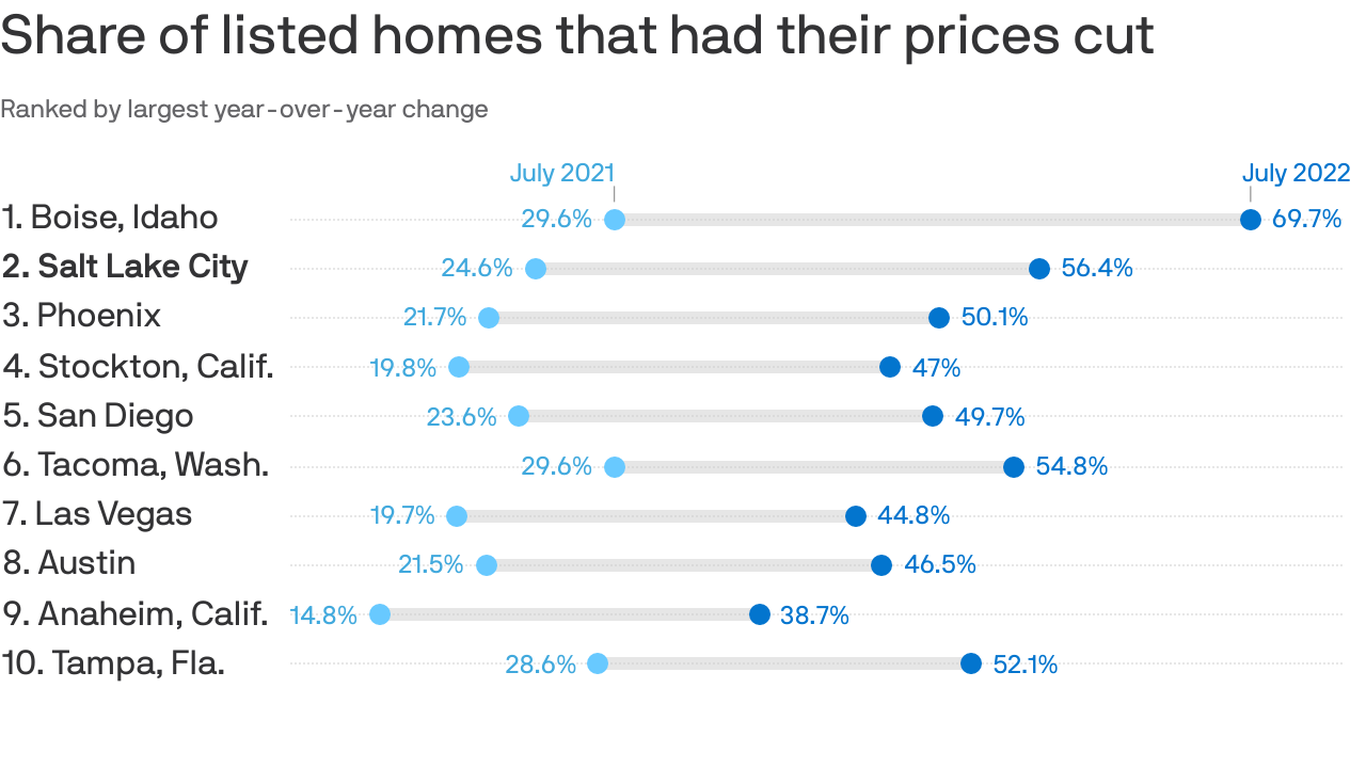
About 56% of Salt Lake City home sellers dropped their asking price in July, according to a recent Redfin report.
The big picture: Utah's capital city ranked third out of 97 of the country's most populous metros for the largest share of home sellers lowering their asking price.
Between the lines: Amid the pandemic, Salt Lake City's housing market saw one of the highest home price increases in the nation, in part, due to outsized housing demand and droves of new residents moving to the state.
Flashback: Nearly a quarter of home sellers lowered their home's price in July of last year, per Redfin.
What they're saying: "My advice to sellers is to price their home correctly from the start, accept that the market has slowed and understand that it may take longer than 30 days to sell," Boise Redfin agent Shauna Pendleton said in the report.
No stories could be found
Get a free daily digest of the most important news in your backyard with Axios Salt Lake City.


